
Last updated June 9, 2026
Seasonal Gate Repair Care for Plano: Year-Round Homeowner’s Guide
Here’s something most Plano homeowners don’t realize until it’s too late: the gate that locks up solid in January wasn’t damaged in January. The damage happened in October, when the drain channels filled with debris and nobody thought to check them before the first freeze. Water sat, temperatures dropped below 32°F for the first time, and the expansion cracked a weld or warped a track that looked perfectly fine at Thanksgiving. Plano’s climate doesn’t announce its intentions — it punishes neglect quietly over three seasons and presents the bill in the fourth. This guide breaks down exactly what to inspect and when, so you’re not the homeowner standing in a 28°F driveway wondering why the gate won’t open.
Quick Answer
Seasonal gate care in Plano, TX means running a focused inspection four times a year, calibrated to three specific local threats: extreme summer heat that degrades electronics and wiring insulation, brief but damaging ice events that crack hardware, and expansive clay soil that shifts gate posts off-plane year-round. A 30-minute inspection each season — plus one monthly check of your irrigation runoff — is enough to catch the most expensive failures before they happen.
Table of Contents
- Summer (June–September): Protecting Electronics and Wiring from Thermal Load
- Fall (October–November): The Pre-Freeze Checklist That Prevents January Failures
- Winter (December–February): Ice-Damaged vs. Ice-Stressed Hardware — Knowing the Difference
- Spring (March–May): Post-Winter Alignment and Plano Clay Soil Movement
- Year-Round: How Plano Irrigation Systems Accelerate Gate Post Corrosion
- The 30-Minute Monthly Inspection That Prevents $900 Repairs
- Common Mistakes to Avoid
- When to Call a Professional
- Frequently Asked Questions
- The Bottom Line
Summer (June–September): Protecting Electronics and Wiring from Thermal Load
Plano summers are not just hot — they’re sustained. When temperatures sit above 100°F for stretches of three and four weeks, the inside of a gate motor housing can reach 130–140°F on a sun-exposed post. Most residential gate motors are rated for continuous operation up to around 115–120°F ambient. Above that threshold, the control board starts operating outside its design envelope, capacitors degrade faster, and wiring insulation becomes brittle in ways you won’t see until a wire shorts six months later.
The signs of a heat-stressed control board — before it fails completely — are specific and worth knowing:
- Intermittent operation in the afternoon: The gate works fine at 7 a.m. and refuses to respond at 3 p.m. This is thermal cutout behavior. The board is protecting itself by shutting down, and it will eventually stop recovering.
- Slow or sluggish travel with no mechanical obstruction: When a motor’s lubricant has thinned from heat and the capacitor is losing charge capacity, the gate moves as if it’s pushing against resistance — even when the track or hinges are clean.
- Erratic remote range: A receiver circuit stressed by heat will reduce its sensitivity. If your LiftMaster or Linear remote suddenly requires you to be ten feet closer than it used to, suspect the board before you replace the remote.
What to do: In late May or early June, inspect all exposed wiring runs for cracked or flaking insulation — particularly any runs that face south or west. On FAAC and BFT systems, check the motor housing vents for wasp nests and debris, both of which trap heat against the electronics. If your motor housing is painted black or a dark color, consider a UV-reflective equipment cover during July and August. Ryan handles board diagnostics personally on every service call, so if you’re seeing afternoon dropouts, don’t wait until September to investigate.
Fall (October–November): The Pre-Freeze Checklist That Actually Prevents January Failures
North Texas gets a narrow freeze window — roughly mid-December through mid-February — but the damage from that window is almost always seeded in October and November when the weather still feels forgiving. A two-step fall checklist done before Thanksgiving catches 80% of the failures we see in January and February across Plano’s Legacy West corridor and the Preston Hollow-adjacent neighborhoods near the north boundary.
- Purge moisture from slide gate tracks. Plano’s fall brings enough rain to fill the channel of a slide track with standing water. When that water freezes, it expands against the lower wheel carriage and cracks nylon rollers or bends the track flange. Use a blower or compressed air to clear the channel, then inspect for pooling spots where the grade has settled.
- Inspect drain channels and weep holes in masonry columns. Brick and stone gate columns in many of Plano’s Legacy, Willow Bend, and Stone Creek neighborhoods have weep holes that clog with silt and leaf debris by October. A clogged weep hole holds water inside the column, which freezes and cracks mortar from the inside out.
- Check hinge pin lubrication. Swing gate hinges need a fresh application of lithium grease or a marine-grade penetrating oil before the first hard freeze. Dry metal contracts differently than lubricated metal, and a dry hinge pin in a 22°F night can seize enough to shear a bolt when the motor tries to cycle at 6 a.m.
- Test battery backup systems. Lead-acid backup batteries in Viking, Ghost Controls, and DoorKing systems lose cold-cranking capacity as temperatures drop. A battery sitting at 60% health in November will fail in January. Test it now under load, not during an outage.
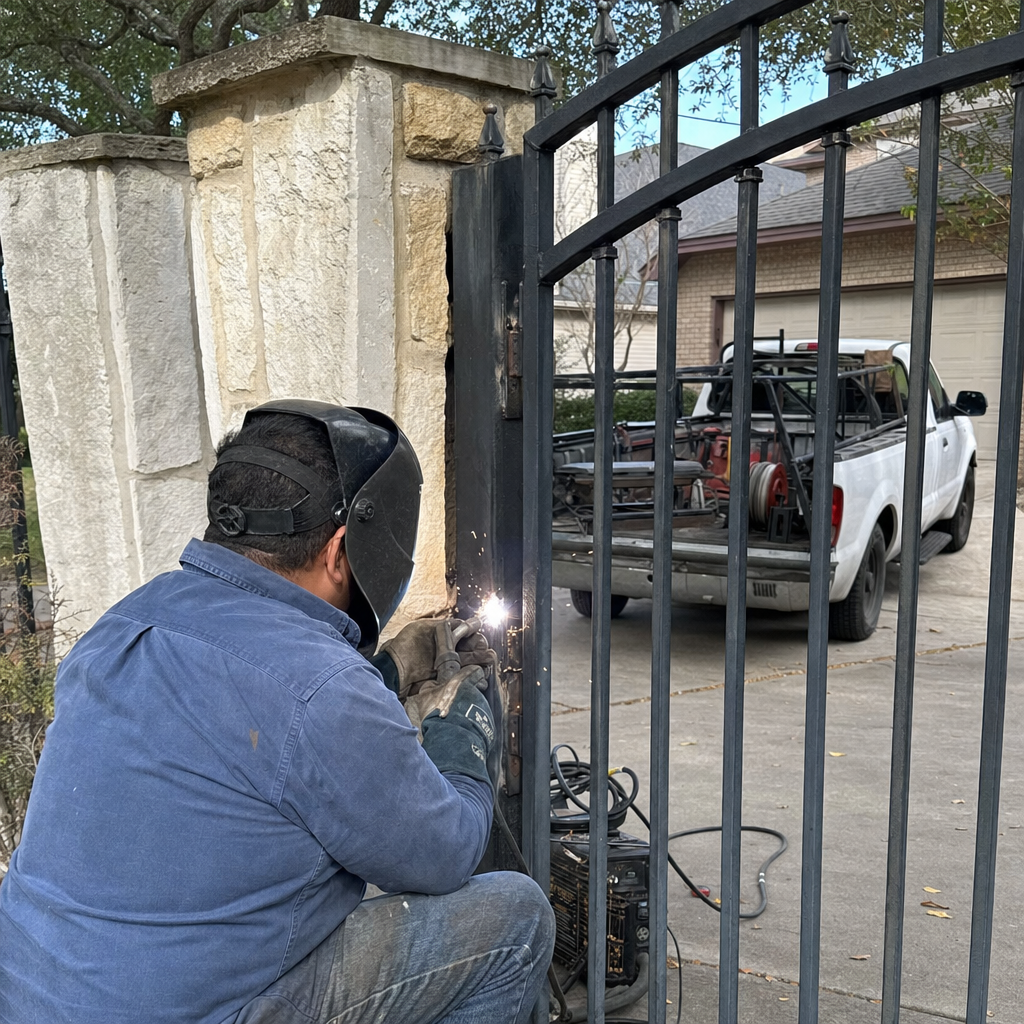
- Inspect weld seams at gate-to-post connections. Thermal cycling between summer and fall stresses weld joints. Run your hand along every structural weld — any roughness, flaking paint, or rust bleeding from a seam line indicates a micro-crack that will open further under ice load.
Winter (December–February): Ice-Damaged vs. Ice-Stressed Hardware — Knowing the Difference
Plano’s ice events are infrequent but severe. Unlike Chicago or Denver, local infrastructure — including residential gates — is not hardened for repeated freeze-thaw cycles. One ice storm that deposits a quarter-inch of glaze on a swing gate can add 40–60 lbs of load to a system designed for the gate’s dry weight only. That’s not a theoretical number — it’s why we see bent top-rail welds in Plano’s Deerfield and Kings Ridge neighborhoods every February.
The distinction between ice-damaged and ice-stressed hardware matters because one requires immediate replacement and the other requires monitoring:
- Ice-damaged: A hinge with a visible crack, a gate that now hangs 2–3 inches lower on the latch side, a weld seam with rust bleeding through a fresh break in the paint. These are structural failures. The gate should not be operated — motor torque against a compromised hinge will accelerate the failure and can strip the motor gearbox.
- Ice-stressed: A gate that cycles more slowly than usual after an ice event, minor stiffness in hinge travel that loosens after five or six cycles, slight misalignment of a slam latch that re-seats itself in warmer conditions. These are stress responses that warrant a close inspection, fresh lubrication, and documentation — but not emergency replacement.
On Elite and Ramset systems, pay particular attention to the limit switch housing after a freeze. Ice intrusion into the housing can shift limit settings, causing the gate to stop short or over-travel. A quick limit adjustment typically resolves this, but if the housing itself has cracked, it needs to be replaced before spring rains enter the electronics.
Spring (March–May): Post-Winter Alignment and Plano’s Clay Soil Problem
This is the season that surprises people the most. Plano sits on a thick layer of expansive Blackland Prairie clay — the same geology that causes foundation movement throughout Collin County and earns pier-and-beam contractors steady work year-round. Gate posts are not immune. When clay absorbs winter moisture and then begins drying in March and April, it contracts and can rotate or tilt a post that was plumb in November by as much as one to two degrees. That’s enough to throw a slide gate’s lower roller out of the track center or cause a swing gate to drag its bottom rail across concrete.
The spring alignment check — 5 steps:
- Use a 4-foot level on both gate posts. Check plumb in both directions — front-to-back and side-to-side. Any deviation greater than ¼ inch over 4 feet is worth documenting and watching. Deviation greater than ½ inch over 4 feet warrants a post reset before summer puts full motor load on the system.
- Walk the gate through a full open-close cycle by hand. Disconnect the motor arm or slide chain and operate the gate manually. You’re feeling for drag, binding, or any point in the arc where the gate lifts or drops. Consistent drag at the same point in the swing often traces back to a shifted post, not a motor or hardware problem.
- Check ground clearance at the latch post. Clay expansion often lifts the latch-side post slightly more than the hinge-side, because latch posts typically have less concrete footing volume. If your gate is now dragging the ground on the latch side after clearing it all fall, the post has moved up.
- Inspect the motor arm connection points. A gate that has shifted off-plane puts lateral stress on the motor arm bracket — a load the bracket isn’t designed to absorb. Look for elongated bolt holes or a bracket that has rotated from its original position.
- Re-calibrate open and close limit settings. Even small post movement changes the geometry enough to require a limit reset on LiftMaster, FAAC, and BFT operators. Run the auto-calibration sequence or set limits manually after any physical alignment work.
Year-Round: Why Plano Irrigation Systems Accelerate Gate Post Corrosion
Almost every residential gate in Plano’s established neighborhoods — Willow Bend, Stone Creek, Estates at Legacy, Deerfield — sits adjacent to an automated irrigation system. That’s not a problem in itself. The problem is spray drift and rotor overspray that puts 15–20 minutes of water directly onto a steel gate post four or five mornings a week, April through October. Over two or three years, that recurring moisture cycle does more post corrosion damage than all of Plano’s rain events combined.
The corrosion typically starts at the soil line — the most vulnerable point on any buried steel post — and works upward inside the post wall where you can’t see it. By the time you notice rust weeping from a seam above grade, the below-grade section may already be compromised. We’ve seen posts in Plano that looked surface-rusty but were structurally sound, and posts that looked merely weathered on the surface but were paper-thin at the footing. The difference almost always traces back to irrigation management.
What to do: Walk your irrigation zones and identify any rotors or spray heads that direct water onto gate posts or the base of masonry columns. Adjust arc and radius to keep spray off the metal. For posts already showing surface corrosion, a 30-minute annual treatment with a rust converter followed by a metal primer and enamel topcoat extends post life significantly. If you’re noticing soft spots or deflection when you push against a post at grade level, that’s a replacement conversation — not a paint conversation.
The 30-Minute Monthly Inspection That Prevents $900 Repairs
Most gate failures in Plano homes aren’t sudden — they’re gradual, and a monthly 30-minute walkthrough catches them at the $150 repair stage rather than the $900 emergency replacement stage. Here’s the sequence we recommend to homeowners who want to stay ahead of the repair curve:
- Cycle the gate three times and watch, listen, and feel. Watch for drift, drag, or misalignment. Listen for grinding, clicking, or motor strain. Feel the control panel housing — it shouldn’t be hot to the touch during normal operation.
- Check all visible weld seams for rust bleed or paint cracking. New rust at a weld seam means the joint is moving. Document it with a phone photo so you can track progression month to month.
- Test the manual release. Every gate motor — LiftMaster, Viking, Ghost Controls — has a manual disconnect. Test it monthly. If it’s stiff or corroded, you’ll find out now rather than during a power outage.
- Inspect the photo-eye sensors. Wipe the lenses with a dry cloth and confirm alignment. In Plano’s summer, spider webs and dust on the lenses cause nuisance reversals that get misdiagnosed as motor problems.
- Check fastener tightness at the motor arm bracket. Road vibration, gate cycling, and thermal expansion loosen mounting bolts over time. A 30-second check with a wrench prevents the bracket from walking off its position over a season.
- Clear debris from the track channel or gate swing path. Plano’s fall brings pecan leaves and in spring, hail damage brings down branches. A 5-minute sweep keeps the system from working against resistance it shouldn’t have to fight.
The entire sequence takes under 30 minutes and costs nothing. What it prevents — board replacements, track replacements, post resets — routinely runs $400–$900 in Plano’s current repair market when deferred maintenance is the cause.
Common Mistakes to Avoid
- Using WD-40 on hinge pins and track rollers. WD-40 is a water displacer, not a lubricant. It evaporates quickly and leaves metal dry — the opposite of what you want heading into a Plano winter. Use lithium grease or a PTFE-based dry lubricant on rollers and hinge pins.
- Ignoring afternoon-only malfunctions in July and August. An intermittent failure that only happens during peak heat is a diagnostic signal, not an anomaly. Owners who dismiss it as “the gate acting up” often face a full board replacement in September that a June inspection would have avoided.
- Running the motor against a frozen or ice-bonded gate. If your gate is frozen shut after a Plano ice event, don’t hit the remote and let the motor strain against the ice. The gearbox will take the damage before the ice does. Break the ice bond manually before engaging the operator.
- Assuming a post is fine because the gate still opens. In Plano’s clay soil, a post can be significantly off-plumb and the gate will still operate — until the motor arm absorbs enough lateral stress to crack its weld or strip its gear. The gate opening is not confirmation the structure is healthy.
- Skipping fall maintenance because the gate “worked all summer.” Summer operation doesn’t stress hardware the way freeze-thaw cycles do. A gate that ran flawlessly in August can still fail in January if fall maintenance is skipped. These are different failure modes from different causes.
- Caulking over weep holes in masonry gate columns. Some homeowners seal weep holes thinking they’re keeping water out. They’re actually trapping water in. Weep holes are drainage points; blocking them causes interior moisture buildup that destroys mortar from the inside, particularly in Plano’s brick column construction common in Legacy and Willow Bend.
- Replacing the motor when the real problem is a wiring short. Heat-degraded wiring insulation in a UV-exposed conduit run is a common summer failure in Plano. The symptom looks like a motor fault — the gate doesn’t respond, the motor seems dead. An experienced technician checks wiring continuity before condemning the motor. Replacing a $400 board when a $60 wire repair was all that was needed is a costly and avoidable mistake.
When to Call a Professional
Some gate maintenance is genuinely DIY-appropriate: wiping photo-eye lenses, clearing track debris, applying lubricant to hinges, testing the manual release. The line between DIY and professional territory is drawn at anything structural, electrical, or brand-specific.
Call a professional when you see:
- Rust bleeding from a weld seam, particularly at post connections or hinge mounting plates
- A gate that visibly drops or lifts on one side during the swing cycle
- Any post movement confirmed by a level check
- Afternoon-only failures during summer heat (control board diagnostics required)
- Ice event damage — visible cracks, bent rails, or post deflection after a freeze
- Motor that runs but produces no gate movement (gearbox or drive failure)
- Access control systems — DoorKing, Linear, and FAAC panels involve low-voltage wiring that requires brand-specific programming knowledge
First Choice Gate Repair Murphy offers free estimates throughout Plano — call (844) 352-2864 and Ryan will diagnose the problem directly, without sending a subcontractor to guess first.
Frequently Asked Questions
How often should I service my gate in Plano, TX?
A Plano gate needs a focused inspection four times a year — once per season — plus a brief 30-minute monthly walkthrough. Plano’s combination of extreme summer heat, clay soil movement, and ice-risk winters creates failure conditions that change by season, so a single annual service misses the pre-freeze window in fall and the post-shift alignment check in spring. For most homeowners, the four-season approach prevents the majority of unexpected repair calls.
What does gate repair typically cost in Plano?
Gate repair costs in Plano generally range by job type:
- Hinge replacement or adjustment: $120–$280
- Control board replacement (LiftMaster, FAAC, BFT): $250–$500 depending on board model
- Track realignment on a slide gate: $150–$350
- Post reset due to clay soil movement: $400–$900 depending on footing depth and concrete work
- Wiring repair after UV degradation: $80–$220
- Full motor/opener replacement: $450–$1,100 installed
These ranges reflect the Plano market as of 2025–2026. An exact quote depends on gate type, brand, and access. Call (844) 352-2864 for a free on-site estimate.
Can Plano clay soil really damage a gate post?
Yes — Blackland Prairie clay, which underlies most of Plano and Collin County, is highly expansive. It absorbs moisture in winter, expands, and contracts as it dries in spring, producing measurable post movement in gates that were installed perfectly level. In our experience, gates in neighborhoods with heavy irrigation — Willow Bend, Legacy, Deerfield — show post shift symptoms within five to seven years of installation if the footings weren’t engineered for expansive soil conditions.
What’s the best lubricant for gate hinges in Plano’s climate?
A lithium-based grease or marine-grade penetrating oil works best for Plano conditions. The heat tolerance of lithium grease handles the 100°F+ summers, and its water resistance holds up through fall rain and winter ice events. Avoid petroleum-based sprays that thin significantly in summer heat and leave metal unprotected. Apply fresh lubricant in late October before the first freeze and again in April after the last frost risk has passed.
Should I repair or replace my gate motor if it fails in summer?
Repair first — replace only when diagnostics confirm the motor’s core components are beyond service life. A large percentage of summer motor “failures” in Plano are actually heat-stressed control boards, degraded capacitors, or wiring shorts caused by UV damage to insulation. Replacing a functional motor because the board failed is a $400 mistake. Ryan diagnoses the actual failed component before recommending replacement, which is how nearly two decades of gate-only work gets applied to every service call. Call (844) 352-2864 for a free diagnostic estimate.
Is it safe to operate a gate after a Plano ice storm?
Not immediately — and definitely not against resistance. After any ice event, manually inspect the gate before engaging the motor. Look for ice bonding at the track base, visible cracks at hinge welds, and post movement. If the gate moves freely by hand with no binding, it’s generally safe to operate. If there’s any mechanical resistance, break the ice bond manually first, then inspect all hardware before running the motor. Operating a motor against a frozen gate or compromised hinge puts gearbox load far outside design limits and can turn a $200 hinge repair into a $700 motor replacement.
The Bottom Line
Plano’s climate doesn’t forgive deferred maintenance. The clay moves, the summers bake electronics, and the ice events — brief as they are — crack hardware that fall maintenance would have protected. The homeowners who avoid $800 repair calls aren’t doing anything complicated; they’re running a 30-minute monthly check, completing a pre-freeze walkthrough in October, doing a post-shift alignment check in spring, and managing irrigation spray that silently corrodes posts over years. Done consistently, that’s the difference between a gate that runs reliably for 15 years and one that fails every other winter. When something needs a specialist, First Choice Gate Repair Murphy home is the resource — not a general contractor guessing at a system they service once a year.
Written by Ryan Perez, Owner & Lead Technician at First Choice Gate Repair Murphy, serving Plano since 2007.