
Last updated June 9, 2026
Gate Repair Maintenance Checklist for Plano Homeowners
A gate motor that survives a Plano August has passed the hardest test it will ever face — but most failures don’t show up in August. They show up in September, when heat-damaged circuit boards finally stop communicating, seized gears finally strip under load, and capacitors weakened by 100°F ambient temperatures finally give out on a Tuesday morning when you’re already late. After nearly two decades of gate-only service across North Texas, Ryan Perez has tracked the pattern clearly: the month after the stress is when the damage becomes the repair call. This guide gives Plano homeowners a month-by-month maintenance calendar built around the actual weather events that matter here — the January ice, the July heat, the September reckoning — along with the specific checks that catch problems before they become expensive ones.
Quick Answer
A complete gate maintenance routine for a Plano home includes monthly visual inspections, seasonal lubrication (adjusted for heat and cold cycles), a post-ice-storm hinge and weld check, and a battery backup test before summer heat degrades output. Most homeowners need 30–45 minutes four times a year plus a quick monthly walkaround. Doing these consistently prevents the majority of motor, hinge, and control board failures we see across Plano every year.
Table of Contents
- The Plano Seasonal Maintenance Calendar (Month-by-Month)
- The Four Lubrication Points — Slide Gate vs. Swing Gate
- Post-Ice-Storm Inspection Protocol for Plano Winters
- Battery Backup and Solar Panel Checks Before Peak Heat
- The 10-Second Manual Override Test
- Access Control and Entry System Checks
- The Monthly Visual Walkaround — What to Actually Look For
- Common Mistakes to Avoid
- When to Call a Professional
- Frequently Asked Questions
- The Bottom Line
The Plano Seasonal Maintenance Calendar (Month-by-Month)
Generic maintenance guides tell you to service your gate in “spring and fall.” That’s not wrong — it’s just not enough for Plano, where winter means hard freezes that crack cast-iron hinges overnight, summer means sustained heat that degrades lubricants and battery chemistry simultaneously, and fall is when deferred heat damage reveals itself. Here’s the calendar we’d hand to every homeowner in West Plano or Haggard Park.
January – Post-Freeze Structural Inspection
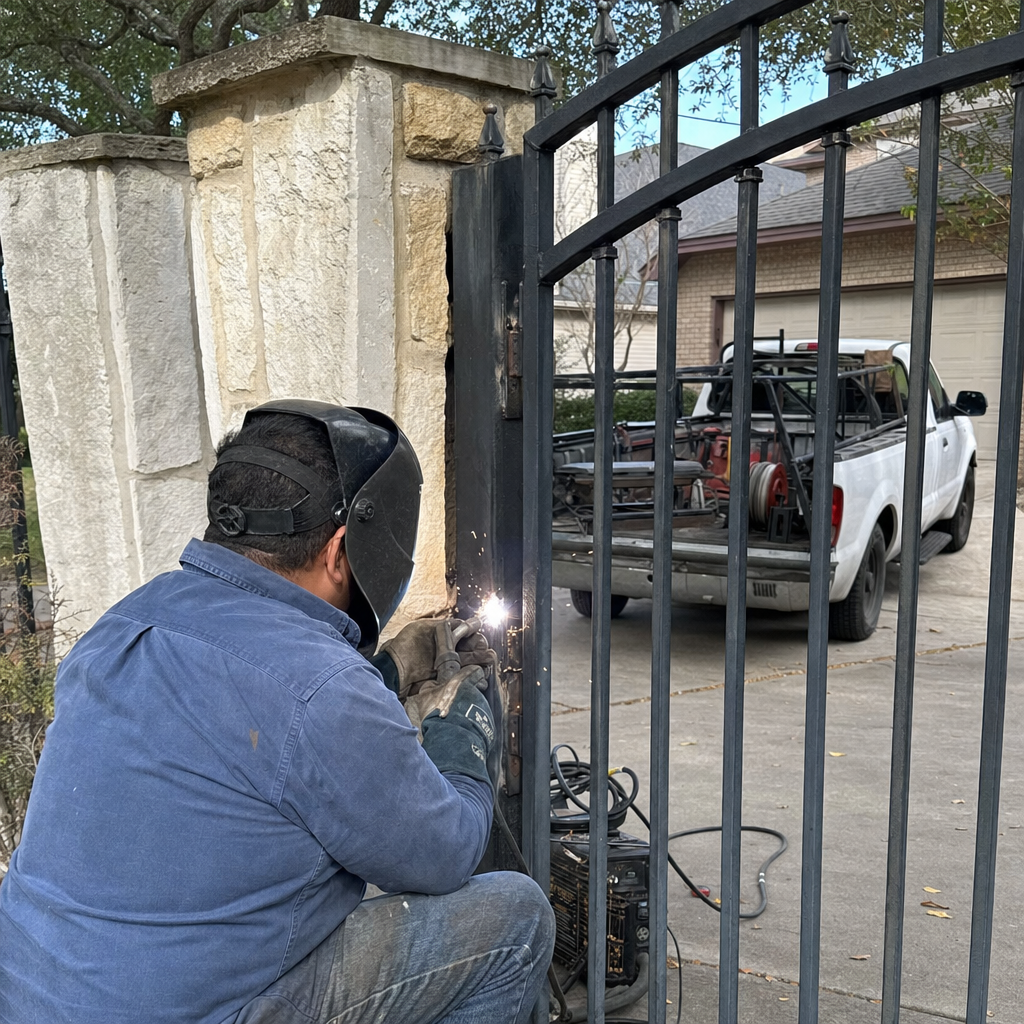
After any hard freeze event (and Plano gets at least two or three per season), walk the gate before operating it. January 2023 and February 2021 both left gate frames cracked at the hinge welds across dozens of properties. Check welds first, then hinges, then the gate panel itself for frame distortion. If the ground shifted during a freeze, posts may have heaved slightly — check gate-to-post clearance before you run the motor.
March – Full Lubrication Service
March is the ideal pre-heat lubrication window. Grease applied in mild temperatures sets properly before summer heat thins it. This is the time to do all four lubrication points (detailed in the next section), test the limit switches, and check the battery voltage baseline before summer draw begins.
May – Control Board and Wiring Pre-Check
Before temperatures push into the 90s, inspect the control board housing. Look for ant intrusion — fire ants are a genuine issue in Plano subdivisions and will build nests inside LiftMaster and FAAC enclosures if the housing seals are compromised. Check all wire terminals for corrosion, and confirm the heat shield or enclosure ventilation is unobstructed.
July – Battery and Motor Thermal Check
Peak heat. Don’t add maintenance stress to an already-stressed system — instead, observe. Note if the gate is cycling slower than usual, if the motor is running hotter than normal to the touch, or if the battery backup is showing a low-charge indicator. Slow cycles in July almost always mean the motor is working harder than it should, which points to a lubrication or alignment issue that needs fixing before it escalates.
September – Post-Heat Damage Assessment
This is the most underperformed maintenance month in Plano, and the one that would prevent the most service calls. After three months of sustained heat, inspect the drive gear for wear, check the control board for any capacitor swelling or burn marks, and test the battery under load. September is when heat-weakened components finally fail — catching them here costs far less than replacing them in October.
November – Pre-Freeze Preparation
Grease all pivot points with a cold-weather-rated lubricant, confirm gate limit adjustments are set correctly (cold metal contracts and can cause the gate to stop short), and test the manual release one more time before winter. If you have a solar-charged system, clean the panel now — winter sun angles in Plano are lower and any panel inefficiency will compound.
The Four Lubrication Points — Slide Gate vs. Swing Gate
Lubrication is the single highest-return maintenance task for any gate system — and also the one most commonly done wrong. Using the wrong grease in the wrong place doesn’t just fail to help; it actively accelerates wear. Here’s what differs between the two most common gate types in Plano residential properties.
Slide Gate Lubrication Points
- Rack gear (drive rack): Use a medium-consistency lithium grease or specifically formulated rack-and-pinion grease. Do not use silicone spray here — it’s too thin to stay on the rack under load and will spin off within days, leaving metal-on-metal contact. Apply a thin, even coat along the full run of the rack.
- Guide rollers and track: A light machine oil on the roller bearings, and a thin coat of white lithium grease on the bottom track channel. Avoid petroleum-heavy products in the track — they attract dust and grit that act as an abrasive against the roller wheels.
Swing Gate Lubrication Points
- Hinge pins and knuckles: This is where we see the most neglect in Plano. Hinges need a penetrating lubricant worked into the pin before a heavier grease is applied over the joint. In our experience, hinges that run dry through one Plano summer are significantly more prone to cracking during the first hard freeze. A dry hinge expands and contracts with no give — a lubricated one flexes microscopically and survives.
- Linear actuator arm pivot points: The clevis pins and pivot brackets on a hydraulic or electromechanical arm (common on BFT and FAAC systems) need a grease that won’t wash out in rain. Do not use a standard silicone spray here — the pivot points on a FAAC Genius or BFT Virgo arm carry real shear loads and need a grease rated for that load, not a lubricant rated for hinges or tracks.
Universal rule: Never use WD-40 as a primary lubricant on any gate component. It’s a water displacer, not a long-term lubricant, and it will displace the grease you actually need.
Post-Ice-Storm Inspection Protocol for Plano Winters
Plano homeowners learned two expensive lessons in February 2021 and January 2023 — ice storms don’t just damage gates through impact, they damage them through expansion, contraction, and the sheer weight of ice on a panel that’s now frozen to its own latch or ground stop. Here’s the protocol to follow after any ice event before you attempt to operate the gate:
- Visual check before power: Walk the full perimeter of the gate. Look at hinge welds, the gate frame corners, and the post-to-foundation connection. Cracked welds often look like a thin dark line — easy to miss unless you’re looking for them specifically.
- Check for ice binding: Never force a gate motor to break the gate free from ice. The torque required will either strip the drive gear, damage the arm, or crack the gate frame. If the gate is frozen to the latch post or ground stop, use warm water (not boiling) to free it manually first.
- Test manual operation before power operation: This is the 10-second manual override test described below. If the gate moves freely by hand after ice clearance, it’s safe to test under power. If there’s resistance, find the source before running the motor.
- Inspect the control board housing for moisture intrusion: Freeze-thaw cycles can compromise housing gaskets. Open the enclosure and look for condensation or water pooling near the board. A single moisture event can corrode terminals and kill a control board within weeks.
- Check hinge play after thaw: Once temperatures normalize, re-check hinges for increased play or wobble. Ice damage often doesn’t present as a visible crack — it presents as a hinge that’s now slightly loose in ways it wasn’t before.
Battery Backup and Solar Panel Checks Before Peak Summer Heat
Battery-backed and solar-powered gate systems are increasingly common on Plano residential properties, especially in newer developments near Legacy Drive and the Willow Bend area where HOA requirements often mandate specific gate configurations. The problem is that most homeowners don’t realize how quickly summer heat degrades both battery capacity and solar output — and a gate that runs perfectly in April may fail during a power outage in August simply because the backup battery has been cooking in a 110°F enclosure for four months.
Battery Check Steps (perform in May, before peak heat)
- Test battery voltage under no load (a charged 12V backup should read 12.6V or higher).
- Test battery voltage under load by triggering three to four consecutive gate cycles — voltage should not drop below 11.8V during operation on a healthy battery.
- Check battery terminal connections for white or green corrosion. Clean with a baking soda solution and re-tighten.
- Replace any battery that’s more than three years old, regardless of how it tests. In Plano’s climate, four-year-old gate backup batteries are statistically unreliable.
Solar Panel Check Steps (perform in October and March)
- Clean the panel surface with a soft cloth and mild soap — dust and pollen accumulation in Plano is significant between cleaning cycles and measurably reduces output.
- Check the panel mounting angle — optimal for Plano’s latitude is approximately 32 degrees. A panel that’s shifted over time due to post movement will underperform through winter.
- Verify the charge controller is showing active charge current during daylight hours. Ghost Controls and LiftMaster solar kits both have LED indicators that make this easy to confirm.
The 10-Second Manual Override Test
This is the most important safety check on this entire list, and almost no homeowner does it until they’re locked in or out of their property. The manual override test tells you two things at once: whether your gate can be operated safely without power, and whether there’s friction or binding in the system that the motor is currently masking by overpowering it.
Here’s how to do it correctly:
- Locate the manual release. On most LiftMaster slide gate operators, this is a lever or pull cord on the side of the motor housing. On BFT and FAAC swing gate systems, it’s typically a key-operated release on the actuator body. Know where yours is before you need it.
- Disengage the motor. Follow the manufacturer’s procedure — do not force the release.
- Attempt to move the gate by hand. A properly maintained gate should move with light, consistent pressure — roughly what you’d use to push a door open. If it requires significant effort, or if it moves freely for part of the travel then catches, you have a mechanical issue the motor is currently hiding.
- Note any grinding, sticking, or uneven resistance. These are diagnostic signals. Grinding at the rack = gear or rack wear. Sticking at a specific point in swing = hinge alignment issue. Resistance throughout travel on a slide gate = roller wear or track debris.
- Re-engage the motor correctly. Confirm the gate is fully in the open or closed position before re-engaging. Re-engaging mid-travel on some systems can cause a limit switch error.
This test takes ten seconds when everything is fine. When it isn’t, it just saved you a breakdown at the worst possible moment.
Access Control and Entry System Checks
A gate that opens and closes correctly is only half the system. The access control components — keypads, loop detectors, intercoms, card readers, and exit sensors — are what turn a gate into a functioning security layer. In Plano, where many residential communities use DoorKing or Viking access control systems, these components deserve their own quarterly check.
What to Check Each Quarter
- Keypad and card reader: Test every active code and credential. Expired codes from previous residents or contractors are a security gap that builds silently over time.
- Vehicle loop detectors: The inductive loops embedded in the pavement detect vehicles for auto-exit. After Plano’s freeze-thaw cycles, pavement around these loops can crack and shift the loop wire. A partially damaged loop may work intermittently — test by driving over it at different points in your vehicle.
- Photo eyes and safety sensors: Test that obstruction detection stops the gate reliably. Hold a piece of cardboard in the beam path during a closing cycle. The gate should reverse immediately. If there’s any hesitation, the sensor alignment needs adjustment before someone’s car or a child occupies that same space.
- Intercom audio quality: If the intercom sounds degraded, check the speaker grille for debris and the wiring connection at the control board. Intercom failures in Plano are disproportionately a late-summer problem — heat expansion loosens terminal connections over time.
The Monthly Visual Walkaround — What to Actually Look For
A monthly walkaround takes five minutes and catches the issues that develop gradually — the ones that look minor until the gate stops working on a Sunday evening. Here’s a practical checklist structured for a Plano homeowner with no technical background:
- Gate alignment: Does the gate close flush against the latch post, or is there a gap at the top or bottom that wasn’t there last month? Gradual misalignment usually means post movement, hinge wear, or gate sag.
- Motor noise: Run the gate once and listen. New grinding, clicking, or laboring sounds during travel are early warnings. A gate that’s louder than it was three months ago is telling you something.
- Weld integrity: Look at the corners of the gate panel and the hinge attachment points for any rust bloom that follows a weld line — that’s often the first sign of a stress crack developing underneath the surface.
- Vegetation clearance: In Plano’s warmer months, vegetation grows fast along fence lines. Confirm there’s nothing encroaching on the gate’s travel path — shrubs, grass overgrowth, or vines can create gradual resistance that the motor compensates for until it can’t.
- Mounting hardware: Tap the main mounting bolts on the motor housing. Any that feel loose should be re-torqued before the vibration cycle from daily operation works them fully loose.
- Status indicator lights: Glance at the control board indicator lights if your system has them. Most LiftMaster, Elite, and Linear systems use LED codes to communicate active faults. A flashing status light that wasn’t flashing last month is worth investigating before it becomes a complete failure.
Common Mistakes to Avoid
- Using silicone spray on rack-and-pinion drive systems. We see this constantly in Plano service calls — a homeowner sprays silicone on the rack because it looks like the right thing to do. Silicone is too thin for load-bearing gear surfaces and spins off within days, leaving unlubricated metal-on-metal contact that scores the rack and pinion gear simultaneously.
- Operating the gate after an ice storm without a manual check first. February 2021 produced a wave of gear-strip and arm-bend failures specifically because homeowners hit the remote without inspecting first. Running a motor against a frozen gate transfers enormous stress to the weakest mechanical link — which is never the ice.
- Ignoring slow operation as “just how it is now.” A gate that’s started cycling noticeably slower is working harder than designed. In Plano’s summer heat, that extra motor load accelerates thermal degradation of the control board. Slow operation is a symptom, not a personality quirk.
- Replacing only the battery without checking the charge circuit. If a gate backup battery died prematurely, the charge circuit may be overcharging it — which will kill the replacement just as fast. A voltage check at the charge terminals before installing a new battery takes two minutes and can save you from replacing the same battery twice.
- Skipping the September post-heat assessment. Because the gate is still working in September, homeowners assume July didn’t damage anything. In our experience across Plano, September is the highest-probability month for control board and capacitor failures — precisely because the gate is still working while the damage from summer heat quietly progresses.
- Calling a general handyman for gate motor or control board issues. Gate control boards are brand-specific and sometimes model-specific. A technician who isn’t familiar with the diagnostic sequence for a LiftMaster SL3000 or a FAAC 740 is guessing, and guessing on a $400–$800 control board is an expensive experiment.
- Assuming a new gate means no maintenance needed. Newly installed gates in Plano subdivisions often need their first limit switch and balance check at the 6-month mark. Drive rack grease applied at installation will thin in the first summer heat cycle. “New” is not the same as “needs no attention.”
When to Call a Professional
DIY maintenance covers a lot of ground — visual checks, lubrication, battery tests, and manual operation tests are all within reach for most homeowners. But there are scenarios where calling someone with genuine gate-system experience is the right move, and trying to push past those thresholds usually makes the repair more expensive, not less.
Call a professional when you notice: any cracked weld or broken hinge pin (structural failures require welding, not patching); a control board that’s showing error codes or fault indicators you can’t resolve with a reset; a motor that’s running but the gate isn’t moving (the drive gear or rack may be stripped and forcing the motor to run makes it worse); any gate that’s drifting open or failing to latch consistently (this is an active security gap, not a low-priority issue); or after any significant ice storm if your post-ice inspection revealed hinge play or frame distortion.
First Choice Gate Repair offers free estimates in Plano — call (844) 352-2864 and Ryan will give you a straight diagnosis, not a replacement recommendation when repair is the right answer.
Frequently Asked Questions
How often should I lubricate my gate in Plano?
For most Plano residential gates, twice per year is the baseline — once in March before peak heat and once in November before freeze season. If your gate runs high cycles (multiple times per day), or if it sits in direct sun, quarterly lubrication of the drive rack and hinge points is more appropriate. Call (844) 352-2864 if you’re unsure which schedule fits your system.
What damage should I look for after a Plano ice storm?
After a hard freeze, inspect hinge welds for hairline cracks, check for gate-to-post misalignment from post heaving, and look for moisture intrusion in the control board housing. Never run the motor if the gate is still frozen to any part of the frame or ground stop — free it manually first. The January 2023 and February 2021 ice events in Plano caused a significant number of cracked hinge welds and stripped drive gears from homeowners powering through frozen gates.
How do I know if my gate’s battery backup needs replacing?
Test battery voltage under load — trigger three to four consecutive cycles and measure voltage during operation. If voltage drops below 11.8V during cycling, or if the battery is more than three years old and Plano summers have been doing their work on it, replace it. A battery that tests fine in the morning but fails during a power outage has often been weakened by heat cycling and is showing you its nominal reading, not its performance under stress.
What’s the most common gate repair call in Plano?
In our experience across Plano, the most frequent calls are for control board failures in September (post-summer-heat damage), cracked hinges or hinge welds following winter freeze events, and drive rack or gear wear on slide gates that haven’t had their lubrication maintained. The September pattern is the most preventable — a May battery check and a post-July assessment would eliminate a significant percentage of those calls.
Can I service my LiftMaster or FAAC gate operator myself?
Lubrication, battery testing, visual inspection, and the manual override test are all reasonable DIY tasks for any gate operator brand. Control board diagnostics, limit switch calibration, and drive gear replacement on systems like LiftMaster, FAAC, or BFT require brand-specific knowledge and, in some cases, proprietary diagnostic tools. Attempting control board repairs without that background is the fastest way to convert a $150 service call into a $600 board replacement.
How long should a residential gate motor last in Plano’s climate?
A properly maintained gate motor in Plano should last 10–15 years. Without maintenance — specifically without regular lubrication, battery management, and post-storm inspections — that lifespan compresses to 5–7 years in North Texas conditions. The combination of sustained summer heat and periodic hard freezes is genuinely harder on gate motor components than the climate in most of the country, which is why the maintenance calendar in this guide is built around Plano’s specific weather calendar rather than generic seasonal advice.
The Bottom Line
A Plano gate that gets consistent, climate-aware maintenance will outlast one that gets serviced only when something breaks — by years, not months. The calendar in this guide is built around the events that actually cause gate failures here: January ice, July heat, September reckoning. The lubrication guidance, the post-storm protocol, the battery checks, and the 10-second manual override test aren’t theoretical — they’re the checks that prevent the service calls we see most often across Plano properties. Build these into your routine twice a year, do the monthly walkaround, and your gate system will give you far fewer surprises.
When something does fall outside DIY territory, Ryan Perez at First Choice Gate Repair Murphy home handles gate diagnostics and repairs personally — not a subcontractor, not a dispatcher routing the next available technician. With 19 years of gate-only expertise and certified service across LiftMaster, FAAC, BFT, Linear, Viking, Ghost Controls, DoorKing, Elite, and Ramset, nearly every gate system in Plano is within scope. Call (844) 352-2864 for a free estimate — Ryan will tell you exactly what’s wrong and what it’ll take to fix it.
You can also explore related services including Gate Repair in Murphy, Gate Installation in Murphy, and Gate Motor & Opener in Murphy for properties across the area.
Written by Ryan Perez, Owner & Lead Technician at First Choice Gate Repair Murphy, serving Plano since 2007.