
Last updated June 9, 2026
The Complete Guide to Gate Repair in Plano
Plano sits on some of the most expansive clay soil in Collin County, and that soil moves your gate posts inches every season whether you see it or not. A gate that swings clean in January may drag, bind, or fail to latch by August — not because the hardware wore out, but because the ground shifted underneath it. Most gate repair guides skip this entirely. This one doesn’t. Below, we cover every major failure mode Plano homeowners actually face: soil-driven post lean, heat-related motor burnout, HOA aesthetic requirements, and the honest question of when a repair makes financial sense versus when the system has simply reached the end of its service life.
Quick Answer
Gate repair in Plano, TX typically costs between $150 and $650 depending on the problem — a simple alignment or sensor adjustment runs on the lower end, while motor replacement or post realignment runs higher. Most mechanical repairs can be completed same-day. Because Plano’s expansive clay soil causes post movement year-round, the root cause of many “mechanical” problems is actually a foundation issue that must be addressed before any hardware fix will hold.
Table of Contents
- How Plano’s Clay Soil Damages Gate Posts and Alignment
- The Three Gate System Types Common in Plano Subdivisions
- Most Common Gate Problems in Plano — and What Actually Fixes Them
- HOA Gate Requirements in Plano: Mechanical Repairs Must Meet Aesthetic Standards Too
- Repair vs. Replace: How to Know When You’re Throwing Money Away
- Why a Dedicated Gate Specialist Outperforms a Garage-Door Company on Gate Work
- Gate Repair Costs in Plano: What to Expect
- Common Mistakes to Avoid
- When to Call a Professional
- Frequently Asked Questions
- The Bottom Line
How Plano’s Clay Soil Damages Gate Posts and Alignment
Plano’s soil profile is dominated by the Austin Chalk and Blackland Prairie clay formations that run through Collin County. This clay is highly expansive — it absorbs moisture during our wet springs and shrinks dramatically during the intense July and August dry periods. Over a typical year, the vertical and lateral movement in that soil can shift an embedded gate post by one to three inches. That’s not a gradual, gentle drift; it’s a cyclical heave that stresses every weld, hinge, and hardware mounting point on your gate system.
What this means practically: a post that was perfectly plumb when your gate was installed in, say, 2018 may be leaning noticeably by now — even if it looks visually straight at a glance. We regularly see this in Plano neighborhoods like Willow Bend, Legacy, and the communities along the Preston Road corridor. The lean puts chronic lateral stress on the swing arm or slide mechanism, which causes the motor to work harder than it was designed to, shortens bearing life, and eventually strips drive gears.
The critical mistake homeowners make is calling for a “tune-up” when the underlying problem is a shifted post. Adjusting limit switches, lubricating the chain, or replacing a worn arm bracket will buy you a few months at best. If the post has moved more than about an inch out of plumb, the correct fix starts with resetting or re-footing the post — ideally with a concrete footer that extends below Plano’s active zone depth of roughly 36 to 42 inches. That’s the only repair that will actually hold through the next heat cycle.
The Three Gate System Types Common in Plano Subdivisions
Plano’s residential gate market is not uniform. The system type you have determines which failure modes you’re most exposed to, so diagnosis has to start here.
1. Swing Arm Gates
The most common type in Plano’s single-family subdivisions built between 1995 and 2015. A swing arm operator — common brands include LiftMaster, FAAC, and Ghost Controls — mounts to the gate post and drives the gate leaf through an articulating arm. These systems are vulnerable to post lean (as described above), arm pivot wear, and — in Plano’s summers — hydraulic fluid breakdown on hydraulic models like the FAAC 402 and BFT Igea series. Hydraulic fluid thins dramatically above 100°F, causing erratic slow-close behavior.
2. Slide Gates
More common on commercial properties, multi-family communities, and larger Plano estate lots where a swing gate would require too much clearance. Slide gate operators from brands like Viking, Linear, and DoorKing ride on a ground track. In Plano, the primary failure point is track distortion — the same clay heave that tilts swing-gate posts can buckle or laterally shift a buried track anchor, causing the gate to bind mid-travel or derail from its rollers. We see this pattern frequently in the Legacy Business Park corridor and in gated communities off Dallas Parkway.
3. Overhead (Vertical Lift) Gates
Less common residentially but present in some of Plano’s newer gated communities and commercial entries. These systems lift the gate panel vertically rather than swinging or sliding. Counterbalance spring tension and cable alignment are the primary service points. Brands like Elite and Ramset appear in these installations. Heat-related cable stretch is a documented issue in North Texas summers, and spring tension requires recalibration after the gate structure settles seasonally.
Most Common Gate Problems in Plano — and What Actually Fixes Them
After nearly two decades working on gates across Plano and the surrounding Collin County area, Ryan Perez has cataloged the repair calls that repeat year after year. Here are the most common, with honest assessments of what actually resolves them.
- Gate won’t open or close fully: In Plano, this is soil movement until proven otherwise. Check post plumb before touching the operator. If the post is leaning, no software or limit-switch adjustment will fix the problem permanently.
- Motor runs but gate doesn’t move: Usually a stripped drive gear or a broken arm bracket. On LiftMaster and Linear units, gear-and-sprocket kits are a common in-the-field repair. On FAAC hydraulic units, check for loss of hydraulic pressure first.
- Gate moves slowly or inconsistently: On hydraulic operators (FAAC, BFT), low or degraded fluid is the most likely culprit — especially after a Plano summer. On electromechanical units, check for binding at the hinge points and verify motor amperage draw isn’t elevated.
- Gate reverses before fully closing: Safety obstruction sensors are misaligned or dirty. Plano’s spring pollen season (late February through April) is notorious for fouling photo-eye lenses. Wipe the lenses before assuming a sensor has failed.
- Access control not responding: On DoorKing and Viking access systems, the first check is the battery backup. Plano’s summer power fluctuations stress control boards. A surge event can knock out the logic board without tripping a breaker.
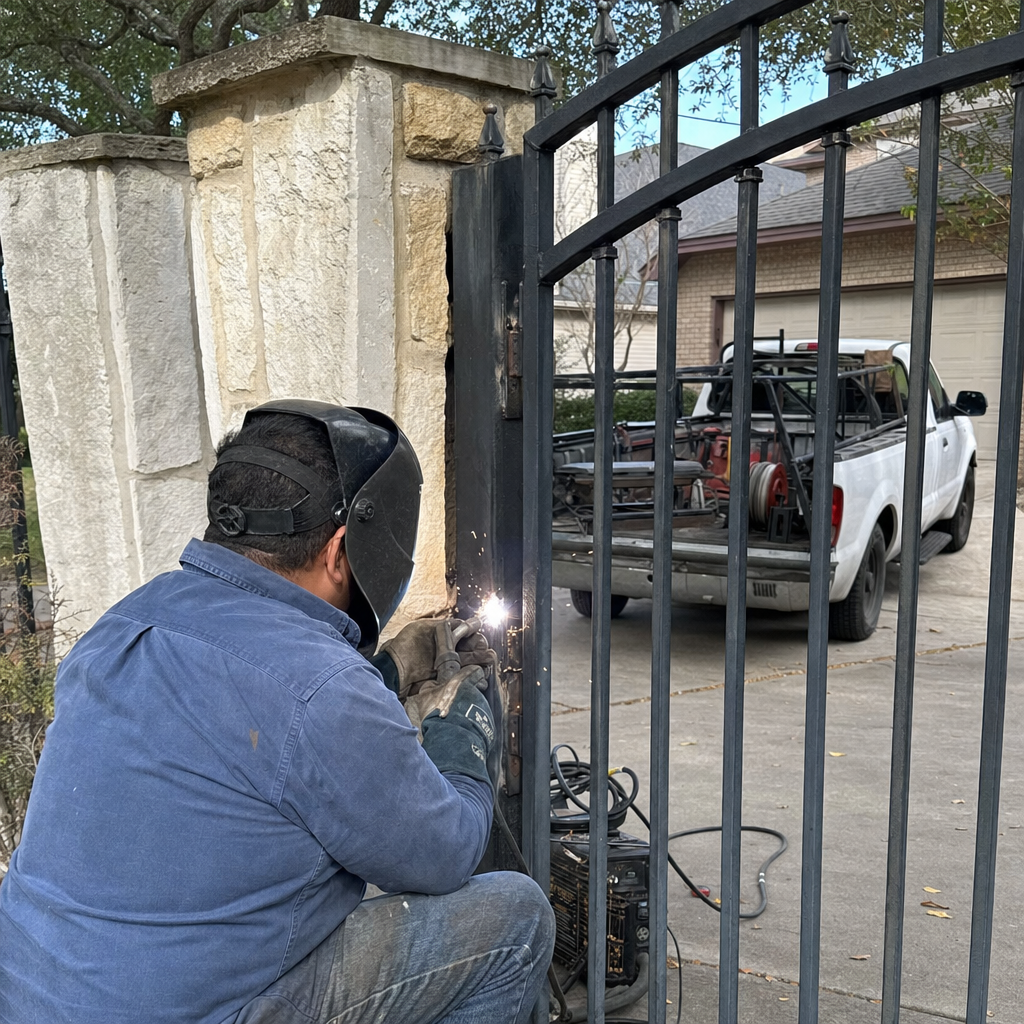
- Gate sags or drags on the ground: Hinge wear on swing gates, roller wear on slide gates. On wrought-iron gates common in Plano’s older Willow Bend and Gleneagles communities, hinge bolts often pull out of the post when the post has shifted — a welding repair is needed, not just a bolt replacement.
HOA Gate Requirements in Plano: Mechanical Repairs Must Meet Aesthetic Standards Too
Plano has a high density of HOA-governed communities — neighborhoods like The Preserve at Prestonwood, Deerfield, Chase Oaks, and dozens of others along the 75 and Dallas North Tollway corridors operate under deed restrictions that govern gate appearance as strictly as gate function. This is a dimension of gate repair that generic guides ignore entirely.
When you repair a gate in an HOA community, you’re not just restoring mechanical function — you’re restoring an approved aesthetic. That matters in several practical ways:
- Paint and finish matching: Replacing a damaged panel section or welding a cracked frame requires finish work that matches the original specification. Mismatched paint or raw welds can trigger an HOA violation notice even if the gate works perfectly.
- Hardware visibility: Some Plano HOAs restrict visible surface-mount hardware. If your swing arm operator has to be repositioned as part of a post realignment, the new mounting position may need HOA approval if it changes the visual profile of the gate.
- Operator housing: Many communities along the Legacy and West Plano corridors require that operator boxes be screened or powder-coated to match the gate or fence line. A replacement motor that comes in a different housing color may need a custom finish.
- Prior approval for structural repairs: If your repair involves concrete work — resetting a post footer, for example — some HOAs classify this as a structural modification requiring a formal approval request before work begins. This is worth a quick email to your HOA management company before scheduling.
In our experience working in Plano communities, proactively matching finishes and flagging any structural work to the HOA before the job saves homeowners from compliance headaches after the fact. A gate that passes inspection mechanically but fails aesthetically means the job isn’t done.
Repair vs. Replace: How to Know When You’re Throwing Money Away
This is the most important honest conversation in gate repair, and it’s one that a specialist — as opposed to someone who just wants to sell you a new system — is better positioned to have. Our position is always repair first, replace only when the numbers or the condition genuinely justify it.
Here’s a straightforward framework for thinking through the decision:
- Check the operator age against its service life. Most residential gate operators have a rated service life of 10 to 15 years under normal cycle loads. LiftMaster, FAAC, and Viking units in that range, properly maintained, often run 18+ years. If your motor is 8 years old and the repair cost is under 40% of replacement cost, repair almost always makes financial sense.
- Assess whether the failure is mechanical or structural. A motor replacement on a gate with a compromised post structure is a waste of money. The structural problem must come first. If the post work plus the motor work together cost more than 70% of full system replacement, a full replacement with a correct footer installation may be the better long-term investment.
- Count your repair history. If you’ve had the same system repaired three or more times in the past two years — and the failures are in different components — the system is degrading across the board. Chasing individual components on an aging system is often more expensive than replacing it.
- Evaluate parts availability. Some older gate system brands have discontinued parts lines. If the logic board on an older Elite or Ramset system can no longer be sourced and has to be custom-fabricated, the economics of repair shift significantly. We maintain our own parts inventory for the nine brands we service, which often solves availability problems — but not always.
- Consider your gate’s functional load. A gate that cycles 20+ times per day on a rental property ages faster than a gate that cycles twice a day at a single-family home. Heavy-use systems reach end-of-life faster, and the repair-vs-replace math changes accordingly.
Why a Dedicated Gate Specialist Outperforms a Garage-Door Company on Gate Work
This is a question worth addressing plainly because a lot of Plano homeowners call a garage-door company for gate work — the thinking being that gates and garage doors are similar electromechanical systems. They’re not, and the difference matters when the diagnosis goes wrong.
Garage-door systems operate on a single axis under controlled load. Gate systems — especially in Plano’s soil conditions — are dynamic structures where the mechanical components interact with a shifting physical environment. Diagnosing a gate problem correctly means understanding soil behavior, structural load, hydraulic systems (FAAC and BFT use hydraulic operators that have no analog in garage-door work), access control electronics, and metalwork. A garage-door technician experienced with LiftMaster residential openers is not prepared for a FAAC 640 hydraulic slide gate operator. We’ve repaired the repairs more than a few times.
Ryan Perez has spent 19 years working exclusively on gate systems. That specialization means he’s seen every failure mode on every major brand — LiftMaster, FAAC, BFT, Linear, Viking, Ghost Controls, DoorKing, Elite, and Ramset — across hundreds of Plano properties. When he arrives at a job, the diagnostic process is not exploratory. It’s pattern recognition built over nearly two decades of gate-only work. That’s a different service than a generalist company that handles gates between garage-door calls.
For complex access control work — multi-user DoorKing systems, Viking telephone entry, or BFT intercoms — the gap between a specialist and a generalist is even wider. These systems require brand-specific programming knowledge that can’t be improvised on-site.
You can learn more about our full service scope and what sets us apart at the First Choice Gate Repair Murphy home page.
Gate Repair Costs in Plano: What to Expect
Plano’s gate repair market reflects both the density of gated communities in Collin County and the cost of skilled specialist labor. Here’s a realistic breakdown of what common repairs run in this market.
| Repair Type | Typical Cost Range (Plano Market) | Notes |
|---|---|---|
| Sensor / photo-eye realignment or replacement | $95 – $175 | Often same-day; pollen season (Feb–Apr) common trigger |
| Drive gear or sprocket replacement | $150 – $280 | LiftMaster and Linear most common; in-stock parts typical |
| Hydraulic fluid service (FAAC / BFT) | $120 – $220 | Recommended every 3–5 years in North Texas heat |
| Swing arm replacement | $185 – $350 | Price varies by brand and arm length |
| Logic board / control board replacement | $220 – $480 | Surge damage is common after Plano summer storms |
| Post realignment (minor — no concrete) | $250 – $420 | Clay soil movement; temporary fix without footer work |
| Post reset with concrete footer | $450 – $850 | Permanent solution; footer depth matters in Plano’s clay |
| Full motor / opener replacement | $380 – $750+ | Brand and system type determine range; installation included |
| Welding repair (hinge pull-out, cracked frame) | $150 – $400 | On-site welding capability; no outsourcing delay |
| Access control programming / reset | $95 – $250 | DoorKing, Viking, BFT — brand-specific knowledge required |
These are Plano-market ranges based on current parts and labor costs. Final pricing depends on brand, system age, and whether structural work is needed. Call (844) 352-2864 for a free estimate — no obligation, and Ryan will tell you honestly whether a repair or a replacement makes more sense for your specific system.
If you’re in the Murphy area and also need to evaluate a full new system, our Gate Installation in Murphy page covers what to expect from a new installation, including system type selection and brand recommendations by use case.
Common Mistakes to Avoid
- Adjusting limit switches before checking post plumb. In Plano, this is the most common wasted service call we see. Limit switch adjustment on a leaning post is like adjusting your car’s alignment without fixing the bent frame — it won’t hold, and it delays the real diagnosis.
- Skipping the hydraulic fluid service on FAAC and BFT operators. Plano’s summers regularly push ambient temperatures above 100°F, which degrades hydraulic fluid faster than the national service schedule assumes. Running a hydraulic operator on old fluid causes erratic behavior that gets misdiagnosed as a motor or board problem.
- Using a generic lubricant on gate hardware. WD-40 and standard household oil attract clay dust — and Plano generates a lot of it, especially during dry summer months. Use a dry PTFE lubricant or white lithium grease on rollers, hinges, and drive chains. The wrong lubricant turns into an abrasive paste within weeks.
- Assuming an HOA repair can be done without finish matching. Several Plano communities along the 121 corridor have issued violation notices after gate repairs left mismatched paint or visible raw welds. The mechanical fix was done correctly; the cosmetic work wasn’t. Budget for finish matching from the start.
- Hiring a garage-door company to reprogram a DoorKing or Viking access system. These are brand-specific platforms with proprietary software. Incorrect programming attempts can lock out all users or corrupt the access database. This is not theoretical — we’ve received calls from Plano property managers after exactly this scenario.
- Delaying post repair because the gate still “kind of works.” A gate that’s binding on a shifted post is drawing elevated amperage from the motor every cycle. That accelerated wear compounds quietly. By the time the motor fails, what could have been a $350 post adjustment has become a $350 post adjustment plus a $450 motor replacement.
- Sourcing replacement parts online without confirming compatibility. Drive gear kits and arm brackets sold online for popular brands like LiftMaster and Ghost Controls often have model-specific tolerances. An incorrect-fit part installed under stress will fail faster than the original. When in doubt, confirm the part number with someone who knows the brand before ordering.
When to Call a Professional
Some gate issues — wiping a photo-eye lens, lubricating a hinge, resetting a tripped breaker — are genuinely homeowner-serviceable. But several scenarios call for a specialist immediately:
- The gate post is visibly leaning or the gate is dragging on the ground — structural issues that worsen with every cycle.
- The motor runs but produces no movement, or runs briefly then trips — potential gear failure or electrical fault that can damage the motor further if ignored.
- A vehicle or object has struck the gate — impact damage often includes hidden structural stress that isn’t visible without a close inspection.
- The access control system has stopped accepting credentials after a power event — logic board damage from Plano’s summer storm surges.
- Welding is needed at hinge points or on the gate frame — field welding on an operational gate requires proper equipment and knowledge of load distribution.
- The gate system is 12+ years old and showing multiple simultaneous issues — this is the repair-vs.-replace conversation, and it deserves an honest specialist’s assessment, not a patch job.
First Choice Gate Repair Murphy offers free estimates in Plano — Ryan Perez personally handles the diagnostic visit, so you’re getting 19 years of gate-specific experience on the call, not a sales technician. Call (844) 352-2864 to schedule. If you’ve also been evaluating your motor or opener separately, our Gate Motor & Opener in Murphy page walks through how to compare operator specifications by system type and cycle rating. And if you’re exploring options in a neighboring area, our Gate Repair in Murphy page covers the same depth of service just east of Plano.
Frequently Asked Questions
How much does gate repair cost in Plano, TX?
Gate repair in Plano typically runs $95 to $850 depending on the problem. Simple fixes like sensor realignment or a fluid service land under $200; structural work like post resetting with a concrete footer runs $450–$850. Motor or board replacements fall in the $350–$750 range. The most accurate estimate comes after a physical look at your system — call (844) 352-2864 for a free on-site estimate with no obligation.
Why does my gate keep going out of alignment in Plano?
Plano’s Blackland Prairie clay soil expands and contracts significantly with moisture changes, and that movement shifts gate posts seasonally — often by one to three inches over several years. A gate that realigns fine in spring may bind or fail to latch by late summer. The permanent fix is a post reset with a footer that reaches below Plano’s active soil zone (roughly 36–42 inches). Surface-level adjustments will not hold through the next heat-and-drought cycle.
Can you repair any gate brand, or only certain ones?
First Choice Gate Repair Murphy works on nine major brands: LiftMaster, FAAC, BFT, Linear, Viking, Ghost Controls, DoorKing, Elite, and Ramset. That covers the vast majority of gate systems found in Plano-area homes and commercial properties. For access control platforms like DoorKing and Viking, brand-specific programming tools and experience are required — this is an area where a specialist matters significantly more than for basic mechanical work.
My HOA requires gate repairs to match the original appearance. Can you handle that?
Yes. In Plano’s HOA-dense communities, matching the original finish is part of the job, not an afterthought. We handle on-site welding and work with homeowners to match paint and powder-coat finishes to HOA specifications. For structural repairs that may require HOA pre-approval — post replacements, for example — we recommend notifying your HOA management company before work begins, and we can provide documentation of the scope of work if needed.
Is it worth repairing an older gate system, or should I replace it?
If the operator is under 12–14 years old and the current repair addresses a single, isolated failure, repair almost always makes financial sense — especially if the post structure is solid. If the system has had multiple repairs in the past two years, the post has structural problems, and the operator is past its rated service life, replacement with a correctly installed new system often costs less over five years than continued repairs. Ryan will give you a straight answer on which scenario applies to your gate — call (844) 352-2864 for that conversation.
How quickly can you get to a gate repair in Plano?
Most Plano repair calls are scheduled within one to two business days, and many common mechanical failures are resolved on the first visit because Ryan carries in-stock parts for the nine brands he services. For situations where a gate is stuck open and poses a security concern, call directly at (844) 352-2864 to discuss urgency — same-day scheduling is available when the calendar allows.
The Bottom Line
Gate repair in Plano isn’t just a mechanical problem — it’s a soil problem, a climate problem, and in HOA communities, an aesthetic problem. A guide that ignores Plano’s expansive clay, the Collin County heat cycles, and the dense HOA landscape is only telling you part of the story. The most important takeaways from everything above: identify whether your post has shifted before touching the hardware; match your repair approach to your specific system type; and get an honest repair-vs.-replace assessment from someone who works on gates exclusively. That last point matters more than it might seem — a specialist who has seen 19 years of Plano gate failures diagnoses differently than a generalist who handles gates on the side. If your gate isn’t working the way it should, call (844) 352-2864 for a free estimate. Ryan will look at it personally, tell you what’s actually wrong, and tell you straight whether a repair or a replacement is the right move for your situation.
Written by Ryan Perez, Owner & Lead Technician at First Choice Gate Repair Murphy, serving Plano since 2007.