
Last updated July 7, 2026
Gate Repair Permits, Codes & Inspections in TX: What You Need to Know
Here’s a scenario we see play out in Plano more often than it should: a homeowner swaps out a failed LiftMaster operator, no permit needed, zero issues. The same homeowner later has a post reset after soil shift — a project that almost certainly requires a permit — and skips the paperwork assuming it’s just another repair. The inspector flags it during a home sale two years later. Escrow holds. Panic sets in. The threshold between “no permit required” and “permit required” in Texas isn’t about the dollar amount you spend or the hours it takes — it’s about whether structural work is involved. This guide walks you through exactly where that line sits, how Plano and Collin County requirements layer on top of state code, and what it costs to get it wrong.
Quick Answer
Most gate motor swaps and like-for-like hardware replacements in Texas do not require a building permit. A permit is generally required when work involves structural alteration — resetting or replacing posts, modifying the gate foundation, changing gate width, or relocating the gate opening. In Plano, those rules flow from the city’s adopted version of the International Building Code, and HOA architectural approval may be required on top of the municipal permit, not instead of it.
Table of Contents
- How Texas Code Defines the Permit Threshold for Gate Work
- Plano and Collin County Requirements: Where State Code Ends and Local Rules Begin
- HOA Architectural Approval vs. Municipal Permit: You May Need Both
- What Happens When Unpermitted Gate Work Shows Up During a Home Sale
- The Contractor’s Role in Permit-Pulling: Who’s Responsible and How to Confirm It
- What a Gate Inspection Actually Covers in Texas
- Common Mistakes to Avoid
- When to Call a Professional
- Frequently Asked Questions
- The Bottom Line
How Texas Code Defines the Permit Threshold for Gate Work
Texas adopts the International Building Code (IBC) and International Residential Code (IRC) at the state level, and municipalities like Plano amend and enforce those locally. The governing principle for whether a permit is required isn’t the cost of the job — it’s whether the work constitutes a structural alteration versus a repair or replacement in kind.
Under the IRC, “repair” is defined as the reconstruction or renewal of any part of an existing structure for the purpose of its maintenance. “Alteration” covers any change to the structural components. For gate systems, the practical split looks like this:
- No permit typically required: Replacing a gate operator with the same or equivalent unit (swapping a failed Elite operator for a new one of similar capacity, for example); repairing or replacing gate boards, slats, or pickets in kind; lubricating hinges, adjusting travel limits, replacing sensors, repairing control boards or wiring to the motor.
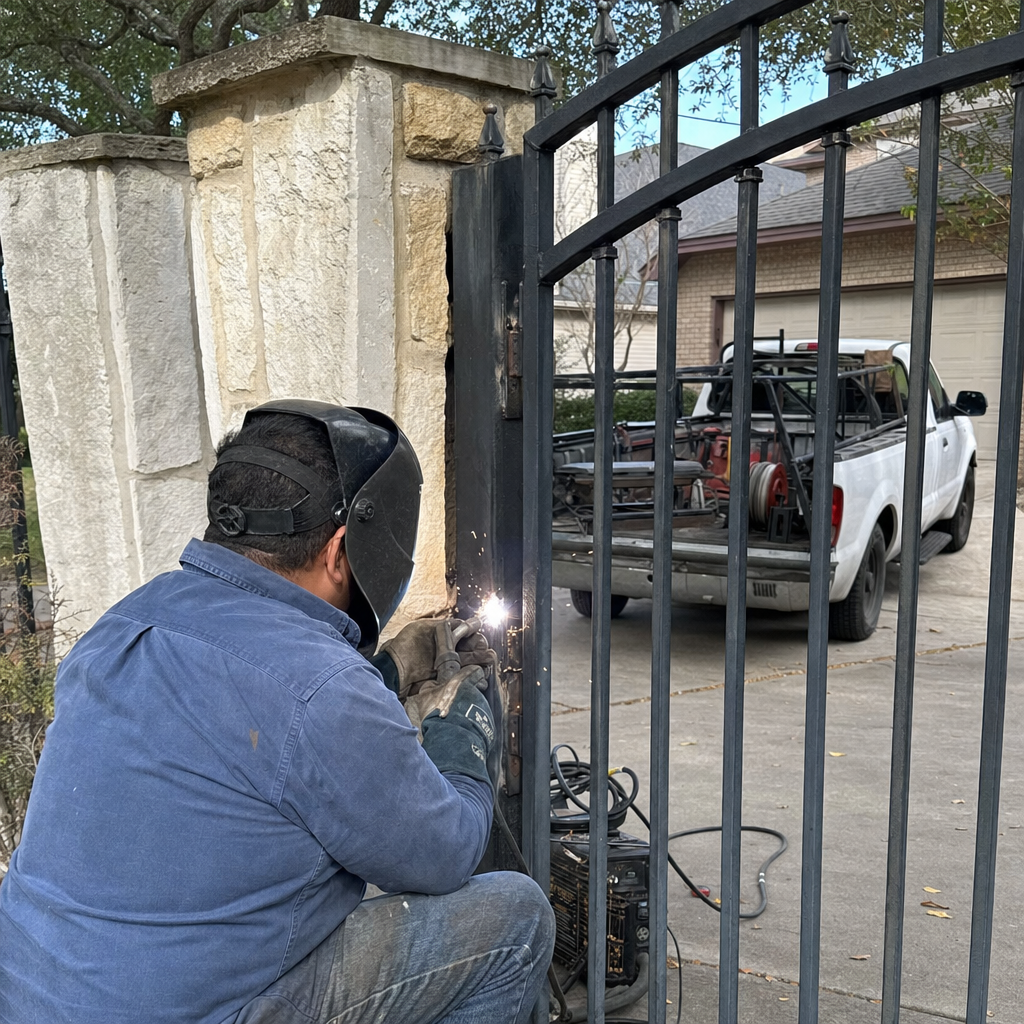
- Permit typically required: Resetting a post that has shifted or heaved (this involves excavation and concrete work — structural by definition); widening or narrowing the gate opening; relocating the gate to a different position on the property; adding a new gate where none previously existed; replacing deteriorated posts with posts of a different size, depth, or material spec.
The line that surprises most homeowners: post work is structural, even when the post looks like a minor fix. North Texas expansive clay soil — the same black gumbo that buckles driveways in West Plano subdivisions — causes post heave and lean constantly. Resetting those posts means new concrete footings, and that’s a permitted scope almost every time. We’ve seen homeowners lose thousands correcting unpermitted post work that was flagged years after the fact.
If you’re ever uncertain, the burden-of-proof move is to call the Plano Development Services department directly and describe the scope. They’ll tell you quickly, and that phone call protects you.
Plano and Collin County Requirements: Where State Code Ends and Local Rules Begin
Texas gives municipalities significant authority to amend the base IBC/IRC, which means Plano’s adopted code can — and does — add requirements that go beyond the state baseline. Plano currently enforces an amended version of the IBC, and the city’s permit thresholds for fences and gates follow that framework.
Here’s what’s specific to Plano that often catches property owners off guard:
- Fence and gate permits in Plano are required for any new fence or gate construction, as well as for structural replacement of existing fence posts or foundations. Cosmetic replacement (same material, same height, same location) typically does not require a permit.
- Plano has height restrictions that vary by zoning: residential gates in front yards are generally limited to a maximum height of four feet, while rear and side yards allow higher structures. Exceeding those heights triggers both a permit and potentially a variance review.
- Electric gate operators near a public right-of-way may require additional review by Plano’s Engineering department, particularly in neighborhoods with narrower setbacks — a common situation in older East Plano subdivisions.
Collin County’s jurisdiction comes into play for properties in unincorporated areas of the county — places that don’t fall within Plano’s or another municipality’s city limits. In those cases, Collin County enforces Texas state code directly, with fewer local amendments. The practical result: unincorporated Collin County properties often have a lighter permitting burden than Plano proper, but you still need to verify, because a large lot on the eastern edge of the county that looks “rural” may have been annexed by a municipality you weren’t aware of.
The governing rule of thumb: if your property has a Plano mailing address, treat Plano Development Services as your permit authority. If you’re outside city limits, call the Collin County Development Services office to confirm jurisdiction before any structural gate work begins.
HOA Architectural Approval vs. Municipal Permit: You May Need Both
In Plano, a significant portion of residential properties — particularly in master-planned communities like Willow Bend, Starwood, and portions of Legacy — fall under HOA governance with active architectural review committees (ARCs). This creates a two-track approval process that many homeowners conflate into one, assuming that HOA sign-off replaces a city permit. It doesn’t.
The HOA ARC controls aesthetics and community standards: gate material, color, style, height relative to the surrounding fence, and whether an automated opener is visually acceptable. The city permit controls structural safety and code compliance. These are parallel requirements with different authorities, different timelines, and different consequences for skipping.
Here’s the order that matters:
- Submit to your HOA’s ARC first. ARC review can take anywhere from one week to 30 days depending on the association. Starting here means you don’t pull a city permit for a design the HOA will reject.
- Once HOA approval is in hand, apply for the city permit if the scope requires one. Attach the HOA approval letter to your permit application — some Plano reviewers find this helpful context.
- Schedule the city inspection after work is complete, before closing the scope on your project.
- Notify your HOA that work is complete if required by your CC&Rs. Some associations require a final walkthrough before they close out the architectural request.
Skipping the HOA step first is a common and costly mistake in Plano — you can end up with a permitted gate that the HOA forces you to modify or remove entirely because it doesn’t conform to community standards. HOA fines and forced removal costs are not covered by the city permit process in any way.
What Happens When Unpermitted Gate Work Shows Up During a Home Sale
Real estate transactions in Plano require sellers to disclose known unpermitted work, and home inspectors — particularly the thorough ones common in this market — are trained to flag evidence of structural work that doesn’t show a permit in the city’s system. When unpermitted gate work surfaces during the sale process, the consequences range from annoying to deal-killing.
Typical outcomes when unpermitted gate work is discovered:
- Escrow hold or price renegotiation: Buyers and their lenders want the issue resolved. The seller either corrects it before closing or accepts a credit against the sales price — often more than the permit and correction would have cost originally.
- Retroactive permit application: Plano Development Services does allow retroactive permits, but the process requires an inspection of existing work. If the work doesn’t meet current code (which is common when posts were reset without proper depth or concrete specs), you may be required to open the work and bring it into compliance — meaning excavation after the fact.
- Forced removal: In cases where the work can’t be brought into compliance, the city can require removal. For a gate post set incorrectly, that might mean demo and full reinstallation.
- Title complications: If unpermitted work is significant enough, title insurers may require resolution before issuing a clean policy. This can delay or kill a sale outright.
The cost of a standard fence/gate permit in Plano is modest — typically under $150 for residential work. The cost of retroactive correction during a high-pressure home sale is measured in thousands of dollars and weeks of delay. The math is simple.
The Contractor’s Role in Permit-Pulling: Who’s Responsible and How to Confirm It
In Texas, the permit applicant can be the property owner or a licensed contractor working on the owner’s behalf. For most residential gate work that crosses into permitted scope, the contractor pulls the permit as part of the job — but this is not automatic, and the homeowner cannot simply assume it’s been handled.
Here’s what we recommend to any Plano homeowner before structural gate work begins:
- Ask the contractor directly, in writing: “Does this scope require a permit, and if so, will you pull it, or is that my responsibility?” Get the answer in your contract, not just verbally.
- Verify the permit was actually pulled before work starts. You can check permit status on the City of Plano’s online permit portal using your address. A permit number should exist before a shovel goes in the ground.
- Confirm the inspection was scheduled and passed. A permit that was pulled but never inspected is almost as problematic as no permit at all — because the city has no record of the work being approved.
- Request the final inspection record. Ask the contractor for documentation showing the inspection passed. File that with your homeowner records. You’ll want it when you sell.
At First Choice Gate Repair Murphy, Ryan handles permit-related coordination personally on jobs that cross into permitted structural scope — because 19 years of gate-only work means we’ve navigated Plano’s process dozens of times and know exactly what the reviewers need. When the scope is repair-only and no permit is required, we tell you that clearly and explain why, so you’re not paying for paperwork that doesn’t apply.
Be cautious of any contractor who waves off the permit question entirely without a clear explanation. “We don’t usually bother with permits” is not an acceptable answer for structural gate work in Plano.
What a Gate Inspection Actually Covers in Texas
When a permitted gate project reaches the inspection stage, homeowners are often surprised by what the inspector does and doesn’t evaluate. A city building inspector is checking for code compliance on the structural work — not for operational quality or aesthetic preference.
For a typical permitted gate project in Plano, an inspection will generally cover:
- Post footing depth and concrete encasement: Texas’s expansive soil requires posts to be set deep enough to resist heave. The inspector will look for documentation or visible evidence that footings meet the spec called out in the permit.
- Post plumb and alignment: Gate posts must be vertically plumb within tolerances, and the gate opening must match the permitted dimensions.
- Attachment to existing structure: If the gate is attached to a masonry pillar or existing fence, the connection method matters — lag bolts vs. through-bolts vs. welded brackets are evaluated differently.
- Electrical rough-in (if applicable): Automated gate operators that require a dedicated electrical circuit will typically need a separate electrical permit and inspection, handled by the electrical contractor or, in some cases, covered under a general building permit depending on scope.
What inspectors do not evaluate: whether your FAAC or LiftMaster operator is programmed correctly, whether the travel limits are set properly, or whether the safety sensors are aligned. That’s the gate technician’s domain, not the city’s. After the city inspection passes, the operational commissioning of the gate system — setting force limits, testing obstruction reversal, programming access codes — is handled by the technician, not the inspector.
From our experience on jobs across Plano, inspections on straightforward post-reset work typically pass without issues when the concrete specs and depth are documented. Problems arise when contractors set posts without documenting the footing work, leaving the inspector nothing to verify.
Common Mistakes to Avoid
- Assuming post work is just a repair. Any time a post is removed, reset, or replaced — even one post — you’re likely in permitted territory in Plano. North Texas clay heave is a chronic issue, and resetting a leaning post is structural work, full stop.
- Getting HOA approval after the city permit. In Plano subdivisions with active ARCs, the HOA can require changes that conflict with your permitted design. Always get HOA sign-off first to avoid rework and duplicate permit fees.
- Taking a contractor’s verbal word on permit status. “We handle all that” is not documentation. Ask for the permit number and verify it on the city’s portal before work begins on structural scope.
- Ignoring an open permit. A permit that was pulled but never closed out by a final inspection can flag on a title search. If you inherited a property with an open permit from previous gate work, contact Plano Development Services to resolve it before it surfaces during a sale.
- Treating electrical work as part of the gate scope. Installing a new 120V circuit to power an automated opener is electrical work that needs its own permit in Plano, separate from the gate/fence permit. Skipping the electrical permit is one of the more common oversights we see.
- Upgrading gate height without checking zoning. Plano’s front-yard height limits catch property owners off guard, especially those replacing an old decorative gate with a taller privacy or security gate. Confirm the height is within your zone’s limits before ordering materials.
- Assuming rural Collin County = no requirements. Unincorporated Collin County still enforces Texas state code. The requirements are lighter than Plano’s municipal code, but they’re not zero — particularly for structural work near a county road right-of-way.
When to Call a Professional
You should call a licensed gate specialist before starting any project that involves post work, foundation modification, gate widening, or new gate installation — because these are the scopes most likely to require a permit, and getting the permit pulled correctly before work starts is far cheaper than fixing unpermitted work after the fact.
Beyond permits, call a professional when: an automated gate fails to reverse on contact (a serious safety issue — entrapment forces on swing and slide gates can cause injury); a post is visibly leaning more than a few degrees; welded gate frame components are cracked or separated; or the gate’s electrical supply shows any sign of moisture intrusion.
Ryan Perez at First Choice Gate Repair Murphy provides free estimates on gate work across Plano and can assess permit requirements as part of the initial consultation — no guesswork on your end. Call (844) 352-2864 to schedule.
Frequently Asked Questions
No — replacing a gate motor or opener with an equivalent unit is considered a like-for-like repair in Texas and does not typically require a building permit. This applies whether you’re swapping out a failed LiftMaster, an FAAC operator, or similar units, as long as the structural components (posts, foundation, gate opening dimensions) are unchanged. If you’re also running a new electrical circuit to power the replacement operator, that electrical work may require a separate electrical permit.
In Plano, a permit is required for new gate construction and for work that involves structural changes — post replacement, foundation work, or changes to the gate opening. Cosmetic replacement (same material, same height, same location, no post work) generally does not require a permit. When in doubt, contact Plano Development Services at their permit counter or online portal to describe your specific scope — it takes about five minutes and eliminates all guesswork. Call (844) 352-2864 if you want a contractor’s read on whether your specific job crosses the threshold.
Unpermitted structural gate work discovered during a home sale in Plano can trigger escrow holds, retroactive permit requirements, mandatory code corrections, or — in cases where the work can’t be brought into compliance — forced removal. Sellers are required to disclose known unpermitted work, and home inspectors frequently flag evidence of structural modifications. Resolving unpermitted gate work before listing your home is almost always less expensive than negotiating a credit under sale pressure. Call (844) 352-2864 for a free assessment of your gate’s compliance status before you list.
HOA architectural approval should come first. In Plano communities with active architectural review committees, the HOA can require changes to your gate’s design, material, or height that could conflict with a permit you’ve already pulled. Getting HOA sign-off first means your permitted design is already HOA-approved, and you avoid paying for permits and materials on a design you’ll be forced to change. HOA approval does not replace the city permit — you need both for structural work.
In Texas, either the property owner or a licensed contractor can pull a building permit. For most residential gate work, the contractor pulls it as part of the job scope. However, this is not automatic — you must confirm it in writing before work begins. Ask your contractor explicitly whether the scope requires a permit and who is responsible for pulling it. Verify the permit number on the City of Plano’s online permit portal before any structural work starts, and ask for the final inspection record once work is complete.
Yes. Automated gates positioned close to a public right-of-way in Plano — a common situation in older neighborhoods along Legacy Drive, Spring Creek Parkway corridors, and similar streets — may require review by the city’s Engineering department in addition to the standard building permit. The concern is gate swing clearance, sight-line obstructions, and vehicle stacking distance. If your gate opens toward a street or sits within a narrow setback, flag this specifically when you apply for your permit so Engineering is looped in from the start rather than discovering the issue at inspection.
The Bottom Line
The permit threshold for gate work in Texas isn’t about project cost or complexity — it’s about whether the scope touches structural components. Motor swaps and hardware repairs almost never require a permit. Post work, foundation changes, and new installations almost always do. In Plano, that state framework is reinforced by local amendments that add height limits, HOA overlay requirements, and Engineering review for right-of-way adjacency. Getting this right before work starts costs very little. Getting it wrong surfaces at the worst possible moment — usually when a house is under contract and a closing date is on the line. When structural gate work is on your list, verify the permit requirement first, confirm your contractor is handling it in writing, and keep the final inspection record with your home documents.
For Plano-specific gate repair and installation work — including free permit-scope assessments — visit our Gate Repair in Murphy service page or call (844) 352-2864. If your project involves a new gate system, our Gate Installation in Murphy page covers what the installation process looks like from first assessment through final commissioning. For motor and opener work specifically, see Gate Motor & Opener in Murphy. Ryan handles assessments personally — you’ll talk to the most experienced person in the process from the first call.
Written by Ryan Perez, Owner & Lead Technician at First Choice Gate Repair Murphy, serving Plano since 2007.