
Last updated July 7, 2026
Gate Repair Maintenance Checklist for Plano Homeowners
A gate motor that survives a Plano August has passed the hardest test it will ever face — but most failures show up in September, after the heat has already quietly cooked a control board or fused a gear. That counterintuitive timing trips up a lot of homeowners. They assume a gate that made it through peak summer is fine, then wonder why it fails on a mild October morning. In this guide, we walk through the complete maintenance checklist built around Plano’s actual weather calendar — not generic seasonal advice — so you know exactly what to check, and when, before a small issue becomes a costly repair.
Quick Answer
A complete gate maintenance routine for Plano homeowners covers six core tasks: lubrication at the correct points for your gate type, motor and board inspection before and after peak summer heat, battery and solar checks ahead of July, a post-ice-storm hinge and structural inspection in January, a 10-second manual override test every 90 days, and a visual alignment check after any major thunderstorm. Done on the schedule below, most mechanical failures are catchable before they become emergency service calls.
Table of Contents
- Plano’s Seasonal Stress Calendar — Month-by-Month Tasks
- The Four Lubrication Points (And Why Slide vs. Swing Gates Differ)
- Post-Ice-Storm Inspection Protocol for Plano Winters
- Battery Backup and Solar Panel Checks Before Peak Heat
- The 10-Second Manual Override Test
- Motor and Control Board Checks Around Summer
- Common Mistakes to Avoid
- When to Call a Professional
- Frequently Asked Questions
- The Bottom Line
Plano’s Seasonal Stress Calendar — Month-by-Month Tasks
Generic maintenance guides say “inspect in spring and fall.” That advice was written for no climate in particular, which means it’s optimized for none. Plano’s weather puts stress on gate systems at very specific moments — and missing those windows is how a $90 lubrication job turns into a $600 motor replacement.
Here’s the task calendar we use when Ryan walks through a maintenance call in Plano:
January
- Post-freeze hinge and weld inspection — after any hard freeze, especially ice events, check all hinges and weld points for micro-cracks. (More on this in the ice-storm section below.)
- Test the manual release before the next cold front arrives.
March–April
- Full lubrication service — the freeze-thaw cycle dries out grease faster than summer heat does. Spring is the right time to relubricate before Dallas-area storm season begins.
- Inspect photo-eye sensors after spring mud and pollen season — debris on the lens is the number-one cause of ghost reversals in Plano.
- Check gate alignment after any soil movement; North Texas clay shifts noticeably through wet winters.
May–June
- Battery backup test — run a full load test before July heat degrades capacity. Replace any battery that fails to hold charge for 25+ cycles.
- Inspect solar panel output if your system uses one — clean panels and verify the charge controller before the longest days hit.
- Tighten all hardware: bolts, brackets, and track fasteners expand and loosen over spring temperature swings.
July–August
- Reduce motor run frequency on extreme heat days — above 105°F, limit non-essential cycles if your motor lacks a thermal cutoff. Ghost Controls and Viking residential motors are particularly vulnerable to sustained high-heat cycling.
- Keep the motor housing clear of debris and direct-afternoon-sun exposure where possible.
September–October
- Post-summer board and capacitor inspection — this is when heat damage surfaces. Look for swollen capacitors, burn marks on the control board, or sluggish opening speed that wasn’t there in June.
- Second lubrication of the year — Plano’s summer heat burns off grease faster than most manufacturers assume when setting their service intervals.
November–December
- Inspect weather seals and bottom rail clearance before hard freezes arrive.
- Pre-stage manual override access — know where your release key is before you need it at 7 a.m. during an ice event.
The Four Lubrication Points (And Why Slide vs. Swing Gates Differ)
Using the wrong grease — or greasing the wrong point — is more damaging than skipping lubrication entirely. We see this regularly in Plano: a homeowner applies white lithium grease to a rack-and-pinion drive thinking they’re helping, when that system needs a dry lubricant or specific gear grease that won’t attract the grit and clay dust that North Texas air carries constantly.
Swing Gate: Four Points
- Hinge pins and barrel hinges — use a penetrating oil first to break any rust, then apply a grease rated for outdoor metal-to-metal contact. Do not use WD-40 as a final lubricant; it evaporates.
- Arm pivot points on the operator — the clevis pin and connector arms need a medium-weight grease. On BFT and FAAC swing operators, the arm joint is a known wear point if run dry.
- Lock mechanism and deadbolt — graphite-based lubricant only. Grease in a lock mechanism attracts debris and gums the cylinder within one season in Plano’s dusty summer air.
- Drive screw or hydraulic ram (operator-dependent) — hydraulic operators like FAAC and BFT underground units are factory-sealed; do not attempt to add fluid without confirming the reservoir type. Electromechanical operators with a visible drive screw get a light gear grease on the thread.
Slide Gate: Four Points
- Rack gear (pinion drive) — this is the most commonly mis-lubricated point. Use gear grease, not general-purpose grease. Excess grease on an open rack collects Plano clay dust and creates abrasive paste that accelerates pinion wear.
- Guide rollers and V-groove wheels — a light machine oil or dry PTFE lubricant. Roller bearings on slide gates take the full gate weight and dry out quickly during summer heat.
- Track and foundation rail — clean first, then a very light application of dry lubricant. Never grease an open concrete-embedded track; drainage is compromised and freeze-expansion does the rest.
- Chain drive (if applicable) — chain lubricant only. Standard grease on a chain drive causes slinging at speed and attracts debris onto the drive sprocket.
Post-Ice-Storm Inspection Protocol for Plano Winters
Plano’s January 2023 ice event and the February 2021 freeze were instructive in painful ways. In the weeks after each event, we handled a significant number of calls where the visible damage — a cracked hinge, a weld that had separated — had been present since the storm but the gate was still technically opening and closing. The danger is that a partially cracked weld or hinge doesn’t fail immediately; it fails under load, usually on a busy morning when the gate is cycled repeatedly.
After any ice event in Plano, run this inspection before resuming normal use:
- Visual check all weld points — run a flashlight along every hinge weld, frame corner, and brace junction. Look for rust bleed (orange staining around a weld), cracks in the metal adjacent to the weld bead, or any weld that appears to have separated even partially.
- Check all hinges for deformation — ice loading can bend the hinge barrel without breaking it. A bent hinge binds under load and accelerates motor wear over the following weeks.
- Inspect gate posts at the base — Plano’s clay soil holds water. When that water freezes around the post base, it can shear anchor bolts or crack concrete footings. Push laterally on each post with moderate force; any movement means the footing needs attention.
- Test the manual override before reconnecting power — if the gate resists manual movement, do not run the motor. A bound or ice-swollen gate will strip a gear or trip a thermal overload. Clear the obstruction manually first.
- Inspect photo eyes and sensor brackets — ice weight on a sensor wire or bracket can pull the beam out of alignment. Verify alignment with the indicator light before full operation resumes.
- Check battery backup voltage — extended power outages during ice events drain batteries. A battery that held 12.6V in November may be at 11.8V after a multi-day outage. Anything below 12.0V under load needs replacement.
Battery Backup and Solar Panel Checks Before Peak Heat
May and early June are the window to verify your backup power before Plano’s summer heat begins degrading battery capacity. A sealed lead-acid battery that tests fine at 65°F can drop 20–30% of effective capacity by the time ambient temperatures hit 100°F. That means a battery that seemed healthy in March may not complete a full power-outage cycle in August.
Battery Backup Checklist (Complete by June 1)
- Disconnect gate from shore power and run 10 full open/close cycles on battery alone. A healthy backup battery should complete this without significant voltage drop.
- Check terminal connections for corrosion — green or white buildup on terminals increases resistance and reduces effective current to the motor.
- Verify battery age: most sealed lead-acid gate batteries have a 3–5 year service life in North Texas heat conditions. If yours is approaching year four, budget for a replacement before summer.
- Confirm the trickle charger or float charger is functioning — a failed charger leaves you on a battery that hasn’t been topped off since the last power event.
Solar Panel Checks (If Applicable)
- Clean the panel surface — Plano’s spring pollen season leaves a film that can reduce output by 15% or more.
- Verify panel angle and confirm it hasn’t been bumped or shifted by storm activity.
- Check the charge controller readout; output should be in the manufacturer’s expected range for your panel wattage on a clear afternoon.
- Inspect wiring runs for UV degradation — direct Texas sun breaks down cable jacketing faster than most manufacturers rate for, particularly on south-facing installations.
The 10-Second Manual Override Test
This is the check most Plano homeowners have never done — and it’s the one that matters most when the power goes out or the motor fails. The manual override test tells you whether your gate is genuinely safe or just currently operational. A gate that can’t be opened manually in an emergency is a liability, particularly for homes with limited secondary access.
How to run the test:
- With the gate closed and the motor powered off (or at a point in its cycle where it’s at rest), locate the manual release mechanism. On most residential operators — including Ghost Controls, Linear, and Viking units — this is a release arm, lever, or key-operated disconnect on the motor housing.
- Engage the manual release per the manufacturer’s method. This should take no more than 10 seconds with the correct key or tool.
- Attempt to move the gate by hand through its full travel. A properly maintained gate should move with moderate effort — one adult pushing without straining.
- If the gate resists, binds, or requires significant force, stop. Note where the resistance is occurring (hinge, roller, track, or the operator arm itself) and schedule a service inspection. Do not force it — forcing a bound gate damages rollers, rack teeth, or arm pivot points.
- Re-engage the automatic operator and run one full powered cycle to confirm proper re-engagement.
Run this test every 90 days, and always after any ice event or storm. A gate that passes the 10-second override test is a gate that can be managed safely even when the electronics fail.
Motor and Control Board Checks Around Summer
In our experience servicing Plano gates across nearly two decades, the post-summer window — roughly mid-September through October — is when heat-related failures actually appear. The motor may have been running fine through August because it was still functioning within tolerance, but thermal stress on the control board and capacitors accumulates over 90-plus days of high heat and shows up as a sudden failure when ambient temperatures finally drop.
Pre-Summer (May)
- Verify motor housing vents are clear of debris, wasp nests, and dirt accumulation — this is a surprisingly common cause of overheating in Plano.
- Listen for any grinding, clicking, or hesitation during a full open/close cycle. Early gear wear is audible before it’s visible.
- Check the control board for any signs of moisture intrusion from spring rains — condensation on a board before summer heat hits can cause intermittent errors that get misdiagnosed as motor failures.
Post-Summer (September–October)
- Inspect capacitors on the control board visually — swollen tops on a capacitor indicate thermal failure and the board needs service or replacement.
- Run a timed open/close cycle and compare to baseline. If the gate takes noticeably longer to complete its cycle than it did in May, the motor or gear assembly has degraded over summer.
- Check all wire connections at the board and motor for heat-related loosening — terminal blocks can develop micro-arcing after sustained high temperatures, which shows up as intermittent operation rather than clean failures.
- If your system is a BFT or FAAC operator, check the logic board’s error code readout; both brands log thermal events and the stored codes will tell you whether the motor has been protecting itself silently all summer.
Common Mistakes to Avoid
- Using WD-40 as a gate lubricant. WD-40 is a water displacer, not a lubricant. It evaporates within weeks in Plano’s summer heat and leaves moving parts drier than before, accelerating wear on hinges and rollers.
- Skipping the post-storm inspection. Plano gets significant hail and straight-line wind events every spring. A gate that survived a storm without obvious damage may still have shifted alignment or a bent arm that strains the motor every cycle afterward.
- Over-lubricating the rack gear on a slide gate. More is not better. Excess grease on an open rack becomes an abrasive paste within weeks in Plano’s dusty air and accelerates the pinion wear it was supposed to prevent.
- Running a frozen or ice-bound gate under power. After an ice event, manually verifying the gate moves freely before running the motor is non-negotiable. Forcing a bound gate strips gear teeth or burns out the motor’s thermal protection, turning a $0 problem into a several-hundred-dollar repair.
- Ignoring slow operation as a normal sign of age. A gate that’s noticeably slower than it was six months ago isn’t “just getting older” — it’s signaling a specific mechanical issue, usually a worn capacitor, low battery voltage, or beginning gear failure. Catching it early is almost always cheaper than waiting for a full stop.
- Assuming battery backup is functional because it hasn’t been needed. Gate batteries discharge slowly even when unused. A battery that’s never been called on during a power outage may be deeply discharged and incapable of completing even a single cycle when you actually need it.
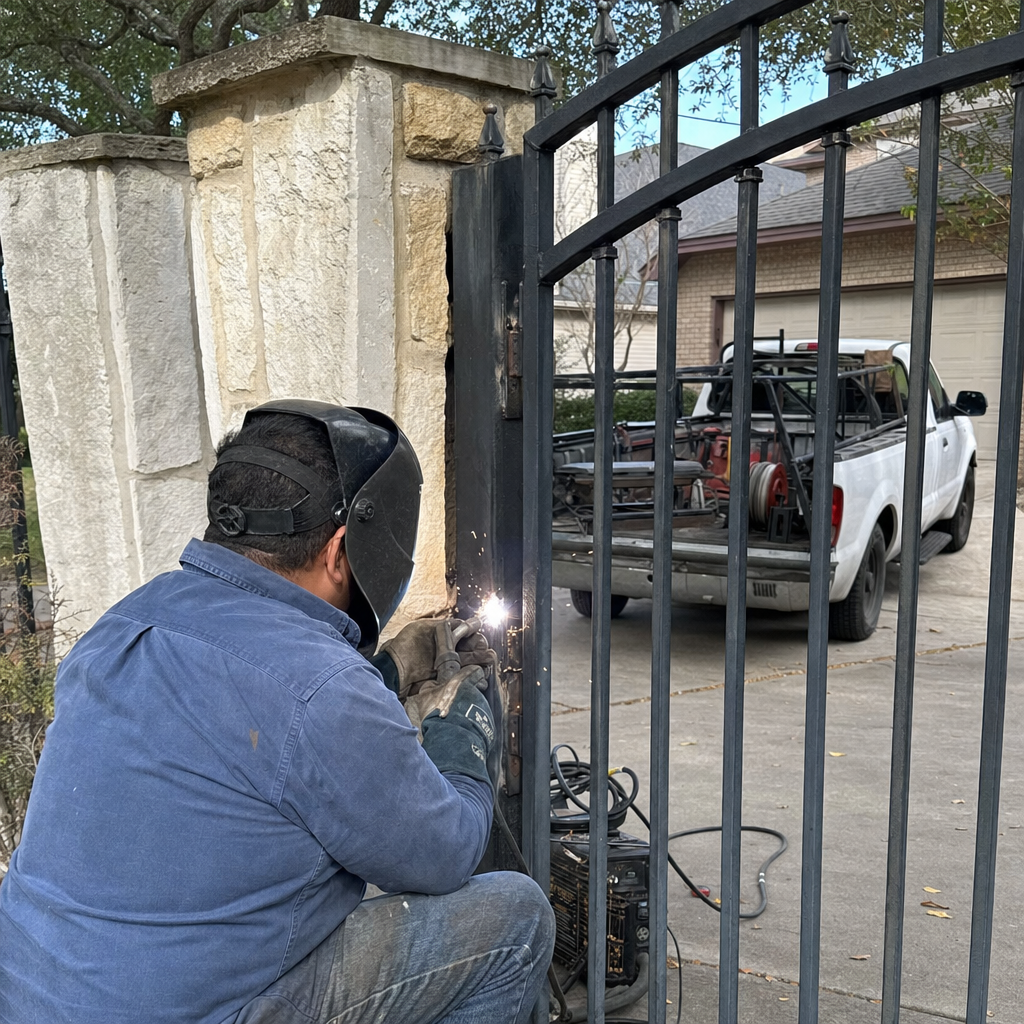
- DIY welding repairs on structural gate components. Hinge welds and frame welds are structural. An improper repair weld may hold for weeks before failing under load — and a gate panel falling on a vehicle or person is a serious safety event. Weld repairs need to be done by someone with actual experience on gate-gauge metal, not a general repair approach.
When to Call a Professional
Some maintenance tasks are genuinely owner-manageable: cleaning photo eyes, replacing batteries, cleaning solar panels, applying lubricant on schedule. Others cross into territory where the risk of getting it wrong is high enough that bringing in a specialist is the right call.
Schedule a professional inspection when you notice any of the following:
- The gate hesitates, reverses unexpectedly, or moves slower than its baseline speed
- You hear grinding, clicking, or any new mechanical noise during a cycle
- The gate doesn’t complete a full cycle reliably under battery power
- Any weld point shows cracking, rust bleed, or visible separation after an ice event
- A post has any lateral movement at its base
- The control board shows an error code or the operator is displaying irregular behavior after a summer of high-heat use
- The gate cannot be moved manually with moderate effort during the override test
First Choice Gate Repair Murphy offers free estimates for Plano homeowners. Ryan Perez handles diagnostics personally — call (844) 352-2864 to schedule.
Frequently Asked Questions
Plano’s climate calls for lubrication twice a year — once in March after the freeze-thaw cycle and once in September after peak summer heat has burned off the first application. Both intervals are faster than what most national manufacturer guides recommend, because those guidelines were written for moderate climates, not North Texas summers. Call (844) 352-2864 if you’d like Ryan to walk through the correct lubricant type for your specific system.
Plano’s January 2023 and February 2021 ice events most commonly produced cracked hinge welds, deformed hinge barrels, and post footing damage from freeze expansion in the surrounding clay soil. Less obvious but equally damaging: batteries drained by extended outages and control boards affected by moisture intrusion when ice melted into motor housings. Run the full post-ice-storm inspection protocol above before resuming normal operation after any hard freeze.
Several tasks are genuinely DIY-appropriate: cleaning photo eyes and sensor lenses, replacing batteries, cleaning solar panels, applying lubricant at the correct points, and running the manual override test. Tasks that need a trained technician include control board diagnostics, weld repairs, post footing work, and any motor or drive system service. Getting the lubrication type or point wrong can cause faster wear than skipping it entirely, so when in doubt, a one-time service call to establish baseline and correct technique is worthwhile.
Most sealed lead-acid gate batteries have a rated life of three to five years, but in Plano’s heat conditions, three to four years is a more realistic expectation for residential systems that cycle frequently. Heat is the primary accelerant of battery degradation — every summer above 95°F shortens the calendar life. Budget for a replacement at year three and test annually from year two onward.
Ryan services nine brands across Plano and the surrounding area: LiftMaster, FAAC, BFT, Linear, Viking, Ghost Controls, DoorKing, Elite, and Ramset. That range covers the vast majority of residential and light commercial gate systems installed in Plano over the past two decades, including some of the European hydraulic operators — BFT and FAAC — that general repair services often decline to touch. Call (844) 352-2864 to confirm your specific model is within scope before scheduling.
Yes — the 10-second manual override test described in detail above. Power the operator down, engage the manual release, and move the gate by hand through its full travel. If it moves with moderate adult effort and no binding, the mechanical system is sound. If it resists, binds, or requires significant force, something in the drive, hinge, or track system needs attention before you resume automated operation. Run this test every 90 days and after every storm or ice event.
The Bottom Line
Gate maintenance in Plano isn’t one-size-fits-all — it’s a calendar problem. The freeze-thaw window in January, the motor-stressing heat of July and August, and the deceptively quiet September when heat damage finally surfaces all demand specific responses. Lubricate twice a year with the right product for your gate type, run the manual override test every 90 days, verify battery capacity before summer, and run a thorough structural inspection after every ice event. Done consistently, this checklist catches 80% of failure conditions before they become emergency calls. When something falls outside what a walkthrough and a wrench can solve, that’s the right moment to bring in a specialist who works on gates exclusively — not as a side service, but as the only thing they do.
For questions about Gate Repair in Murphy or to schedule a free maintenance estimate in Plano, call First Choice Gate Repair Murphy at (844) 352-2864. Ryan handles every diagnostic personally — you won’t be talking to a dispatcher who relays information to a technician you’ve never met.
If you’re considering a new system, explore our Gate Installation in Murphy page for options across the brands we know best. For motor-specific issues, our Gate Motor & Opener in Murphy page covers the most common failure patterns and what to expect on a service call.
Written by Ryan Perez, Owner & Lead Technician at First Choice Gate Repair Murphy, serving Plano since 2007.