
Last updated July 7, 2026
The Complete Guide to Gate Repair in Plano
Plano sits on some of the most expansive clay soil in Collin County, and that soil moves your gate posts inches every season whether you see it or not. Most homeowners notice the symptom — a gate that drags, binds, or refuses to latch — without ever connecting it to the ground shifting underneath. This guide explains what’s actually happening to gates across Plano’s subdivisions, how to tell a fixable problem from a failing system, and what separates a real repair from a temporary patch that costs you twice. By the end, you’ll know exactly what questions to ask before anyone touches your gate.
Quick Answer
Gate repair in Plano, TX typically involves correcting misalignment caused by expansive clay soil movement, repairing or replacing worn motors and openers, and restoring mechanical components like hinges, rollers, and latches. Most repairs can be completed in a single visit by a qualified specialist once the root cause — not just the symptom — is properly diagnosed. Costs in the Plano market generally range from $150–$250 for minor adjustments up to $800–$1,800 for motor replacement or significant structural correction, depending on system type and severity.
Table of Contents
- Why Plano’s Clay Soil Is Your Gate’s Biggest Enemy
- The Three Gate System Types Common in Plano Subdivisions
- The Most Common Gate Failures We See in Plano
- HOA Gate Requirements in Plano Communities
- Repair vs. Replace: How to Know the Difference
- Why a Gate Specialist Matters More Than You Think
- What Gate Repair Costs in Plano
- What You Can Check Yourself — and What You Shouldn’t Touch
Why Plano’s Clay Soil Is Your Gate’s Biggest Enemy
The same dark, expansive clay that makes Plano’s lawns look lush in spring is quietly working against your gate posts year-round. Collin County’s native soil — geologists classify it as Houston Black clay — absorbs water and swells dramatically during wet seasons, then contracts and pulls away from structures during the dry Texas summers. A gate post set in concrete doesn’t sit in a fixed environment; it rides a slow tide of soil expansion and contraction that can displace it by two to three inches over a decade.
That movement rarely announces itself all at once. What you see instead is a gate that starts to drag on the driveway surface, a latch that no longer aligns, or an automated gate that begins grinding because the operator is fighting a path that’s no longer straight. Many Plano homeowners call for a “tune-up” and get one — the technician adjusts the travel limits, lubricates the chain, and the gate works again for six months. Then it doesn’t. That cycle repeats because the tune-up addressed the symptom while the post kept leaning.
A proper repair for a soil-shifted gate in Plano involves assessing post plumb with a level, checking the footing depth (current best practice is 36–42 inches for Collin County soil conditions), and in some cases excavating and resetting the post in a wider, deeper concrete footing. That’s not a simple adjustment — it’s foundational work. Understanding this distinction will save you from paying for the same minor repair three times.
- Wet seasons (November–March): Clay absorbs moisture and expands, pushing posts outward or upward.
- Dry seasons (July–September): Clay contracts and pulls away, sometimes leaving voids around the footing.
- Symptom lag: Post lean from a single season often doesn’t produce noticeable gate problems for 12–18 months — making the cause harder to connect to the effect.
The Three Gate System Types Common in Plano Subdivisions
Plano’s residential development spans several decades and multiple architectural trends, which means the gate systems across its neighborhoods vary widely. Understanding which type you have is the first step toward understanding what can go wrong.
1. Swing Arm Gates
The most common configuration in older Plano neighborhoods — particularly in areas developed through the 1990s and early 2000s — is a single or dual swing gate mounted on vertical posts with a linear arm or articulated arm operator. LiftMaster swing operators are frequent in this category. The primary failure points are hinge wear, arm pivot bushing wear, and post lean (see above). Because the gate swings through an arc, even a few degrees of post displacement creates binding that accelerates mechanical wear dramatically.
2. Slide Gates
Slide gates are standard on commercial properties and increasingly common on Plano estate lots with long driveways where there isn’t enough clearance for a swing gate to open. These systems run on a track or rollers and are driven by a rack-and-pinion or chain operator. Elite and DoorKing operators appear regularly in Plano’s commercial and higher-end residential installations. Common failures include roller wear, track debris accumulation, and rack corrosion — all of which are accelerated by Plano’s summer heat pushing operator temperatures above rated thresholds.
3. Overhead (Vertical Lift) Gates
Less common in single-family residential settings but present in Plano’s mixed-use and multi-family properties, vertical lift gates fold or slide upward. These systems have more mechanical complexity — counterbalance springs, guide tracks, and multi-section panels — and failures tend to be more costly to diagnose without dedicated expertise. The springs on vertical lift gates are under significant tension and should only be adjusted or replaced by a trained specialist.
Safety note: The counterbalance springs on overhead gate systems store enough energy to cause serious injury if handled incorrectly. This is not a DIY adjustment — if your vertical lift gate is binding, stops mid-travel, or makes a loud bang, call a professional before touching the spring hardware.
The Most Common Gate Failures We See in Plano
After nearly two decades of gate work across Plano and the surrounding Collin County area, the failure patterns we see aren’t random. Here are the issues that come up most consistently:
- Post lean and misalignment: As described above, clay soil displacement is the root cause of roughly a third of the service calls we handle in Plano. The gate may look level from the street, but even a 2-degree lean changes the entire geometry of the system.
- Motor and operator failure: Plano’s summer heat is punishing to gate operators. Ambient temperatures regularly exceed 100°F, and an operator mounted in direct sun can reach internal temperatures well above that. Capacitors, circuit boards, and limit switches all degrade faster in this environment. We see more operator failures in September — after the cumulative heat load of summer — than in any other month.
- Hinge wear and gate sag: Heavy wrought iron gates common in Plano’s upscale subdivisions place enormous stress on hinges. Over time, the barrel of a worn hinge allows the gate to sag, dragging the ground and straining the operator motor trying to compensate.
- Access control issues: Keypads, loop detectors, and intercom systems are exposed to rain, direct sun, and physical abuse. Loop detector failures are surprisingly common in Plano because the cutting of concrete driveways for loop installation leaves seams that crack under thermal expansion cycles.
- Latch and safety sensor misalignment: Gate safety sensors mounted close to ground level collect dirt, spider webs, and debris — all of which can trigger nuisance stops or, worse, prevent the gate from registering an obstruction properly.
HOA Gate Requirements in Plano Communities
Plano has one of the highest HOA-coverage rates of any North Texas city, and a significant number of those associations have explicit rules governing gate appearance, materials, and finish — not just mechanical function. Before authorizing any gate repair or replacement in a Plano HOA community, it’s worth confirming what the deed restrictions actually say.
In communities like Willow Bend, Normandy Estates, and several sections of Legacy, HOA architectural guidelines typically specify:
- Material consistency: Replacement hardware (hinges, latches, frame sections) must match the existing material type — wrought iron, aluminum, or steel — and the existing finish color.
- Operator visibility: Some HOAs require that gate operators be concealed from street view or powder-coated to match the gate finish. A bare aluminum operator arm on a black wrought iron gate can trigger a violation notice.
- Post replacement: Replacing a leaning post often requires HOA approval for the new finish and any change in post dimension or cap style.
- Column work: Masonry column repairs — common when a vehicle strikes a pilaster — may require a licensed mason and HOA approval before work begins.
We’ve had Plano homeowners assume that a like-for-like part swap wouldn’t need HOA sign-off, only to receive a violation notice because the replacement hardware had a slightly different finish. When in doubt, check with your HOA management company before the repair begins, not after.
Repair vs. Replace: How to Know the Difference
The honest answer to this question is the one that costs you less over a three-to-five year horizon — not just today. Here’s how we think through it:
Repair is typically the right call when:
- The gate structure (frame, panels, posts) is sound and the failure is mechanical or electrical.
- The operator is under 10 years old and the failure is a component (capacitor, limit switch, circuit board) rather than the motor itself.
- The misalignment is post-lean that can be corrected with a footing reset — the gate and hardware are otherwise in good condition.
- The total repair cost is less than 50% of a comparable new system installed.
Replacement makes more sense when:
- The operator is 15+ years old and has had multiple repairs — at that age, fixing one component often just moves the failure to the next weakest part.
- The gate frame is cracked, extensively rusted, or structurally compromised by a vehicle strike.
- The system uses a discontinued platform where replacement parts are no longer manufactured or are back-ordered indefinitely.
- The repair estimate exceeds 60–70% of the replacement cost and the repaired system carries no meaningful warranty.
Ryan always walks through this calculus with Plano homeowners before recommending a path. The goal is a gate that works reliably for the next several years — not just through the next service call.
Why a Gate Specialist Matters More Than You Think
When a gate stops working, it’s tempting to call whoever is already in your phone — a handyman, a fence company, or a garage-door service that mentions gates on their website. We understand the logic. What we’ve also seen, over 19 years of gate-only work across Plano and Collin County, is what happens when a gate system gets misdiagnosed by someone whose primary expertise is something else.
Gate operators from brands like LiftMaster, DoorKing, and Elite have model-specific diagnostics, limit-setting procedures, and fault codes that vary significantly across product generations. A technician unfamiliar with a specific platform often replaces the most expensive component first — the operator board — when the actual fault is a $40 limit switch or a misconfigured DIP switch setting. We’ve seen Plano homeowners spend $600 on a part replacement from a generalist that didn’t fix the problem, then call us to find a wiring fault that took 20 minutes to correct.
First Choice Gate Repair is structured around gate systems exclusively. Ryan Perez, as both owner and lead technician, brings nearly two decades of focused diagnostic experience to every service call. When you’re dealing with an expensive automated gate system, the difference between a correct first diagnosis and a series of experimental repairs adds up quickly — in dollars and in days without a functional gate.
For a broader look at our work across the region, the First Choice Gate Repair Murphy home page covers our full range of services and the communities we serve.
What Gate Repair Costs in Plano
Pricing for gate repair in Plano varies based on system type, failure severity, and parts required. The following ranges reflect current market conditions in the Plano/Collin County area and are meant as planning benchmarks — not firm quotes, since every gate is different.
| Service | Typical Plano Price Range |
|---|---|
| Diagnostic service call | $75–$125 (often waived with repair) |
| Hinge replacement (per hinge) | $90–$180 |
| Limit switch or capacitor replacement | $120–$220 |
| Gate operator/motor replacement | $650–$1,400 |
| Post reset (footing excavation and reset) | $400–$900 per post |
| Access control keypad replacement | $180–$450 |
| Loop detector replacement | $250–$500 |
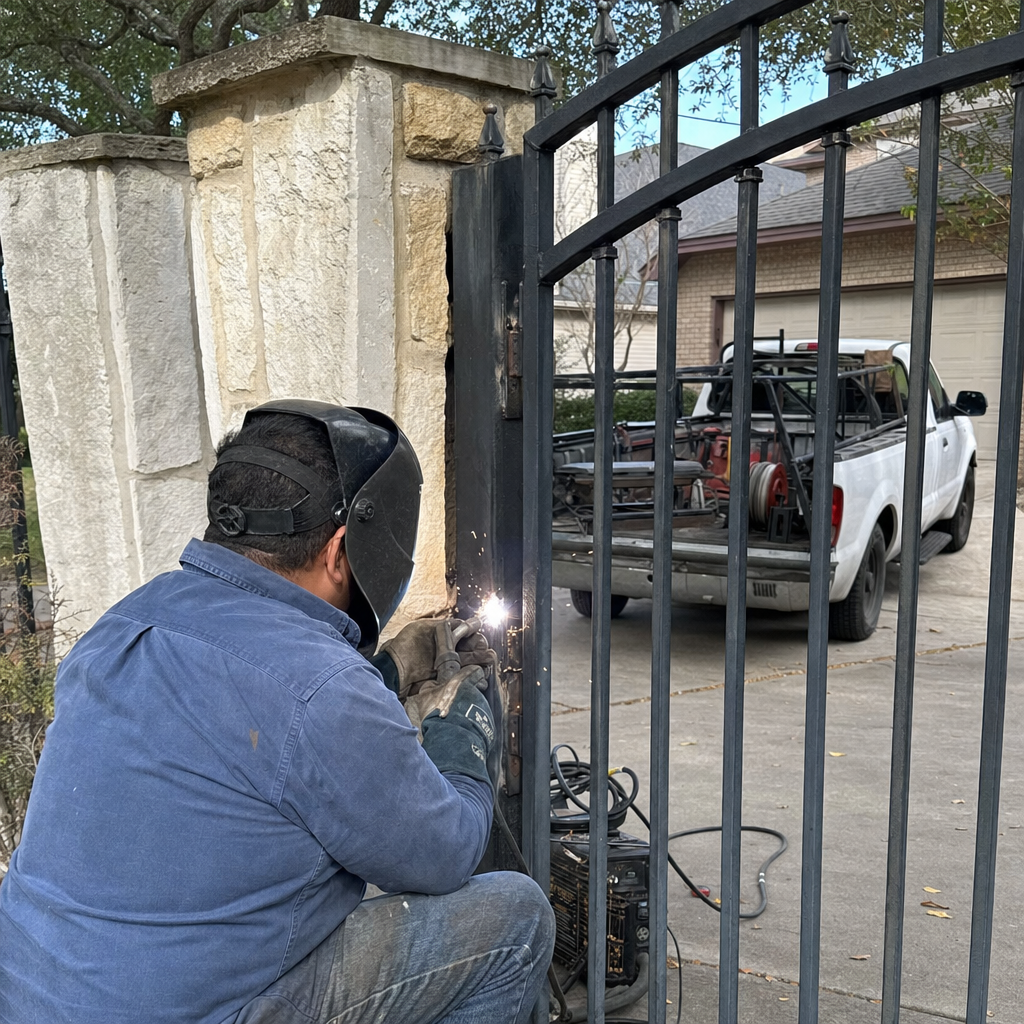
| On-site welding repair (frame/hinge) | $200–$600 depending on scope |
Plano’s labor market and the specialized nature of gate work mean prices sit modestly above national averages found in generic online guides. Get a written estimate before any work begins. Call (844) 352-2864 for a free estimate — we’ll give you a specific number once we’ve seen the system, not a range designed to anchor low and expand.
What You Can Check Yourself — and What You Shouldn’t Touch
There’s a reasonable set of checks any Plano homeowner can run before calling a technician. There’s also a category of work that carries real injury risk and should stay firmly in professional hands.
Safe owner checks:
- Inspect the safety sensors. Clean the photo-eye lenses with a dry cloth and make sure nothing is blocking the beam path. A leaf or spider web can stop a gate mid-cycle.
- Check the battery backup. Many gate operators have a battery that powers the gate during outages. A failed backup battery often presents as slow operation or a gate that stops unpredictably. Most batteries are accessible under the operator cover and can be swapped by following the manufacturer label.
- Look at the gate post plumb. Hold a level against each post vertically. If it reads more than 2–3 degrees off plumb, you have a soil-movement problem, not just a mechanical one.
- Lubricate the hinges and rollers. A light application of white lithium grease (not WD-40, which attracts dirt) on hinge barrels and slide gate rollers can extend component life significantly in Plano’s heat.
- Test the manual release. Know where your gate’s manual release handle is and confirm it works before you need it during a power outage.
Leave these to a trained technician:
- Adjusting counterbalance springs on any overhead or vertical lift gate — these store dangerous amounts of tension.
- Reprogramming access control systems — incorrect configuration can lock you out permanently or disable safety functions.
- Welding structural frame repairs — improper welds on a gate under load can fail catastrophically.
- Post footing excavation and reset — disturbing a footing without understanding soil conditions can accelerate the very problem you’re trying to fix.
Common Mistakes to Avoid
- Treating alignment as a tune-up problem when it’s a foundation problem. If your Plano gate keeps drifting out of alignment after adjustments, the post footing is the issue. Repeated tune-ups on a leaning post just delay the inevitable and add cost.
- Using WD-40 on gate hardware. WD-40 is a water displacer, not a lubricant. In Plano’s dusty summers it attracts grit, accelerating wear on hinges and rollers. Use white lithium grease or a dry silicone lubricant instead.
- Skipping HOA approval before gate repairs. In communities like Willow Bend and Normandy Estates, even a like-for-like hardware swap can trigger a violation if the finish doesn’t match. Confirm with your HOA management company first.
- Hiring a garage-door company for gate motor work. Gate operators have brand-specific diagnostic logic and wiring configurations that differ significantly from garage-door openers. A misdiagnosis from a generalist often leads to unnecessary parts replacement before the real fault is found.
- Ignoring slow operation as a warning sign. A gate that cycles noticeably slower than it used to is often a capacitor failing, a battery degrading, or a mechanical binding issue developing. Addressed early, each of these is a modest repair; ignored until the gate stops entirely, the damage is usually worse and more expensive.
- Replacing an operator without correcting the root cause. A brand-new operator mounted on a leaning post in expansive Plano clay will fail on the same timeline as the one it replaced. New hardware doesn’t fix a structural problem.
- Assuming any repair meets HOA standards for aesthetics. Mechanical function and HOA compliance are separate requirements. A gate can work perfectly and still earn a violation notice for mismatched hardware finish or a visible operator arm that violates architectural guidelines.
When to Call a Professional
Call a gate repair specialist — not a handyman — when your gate shows any of the following:
- The gate stops mid-cycle, reverses unexpectedly, or displays a fault code on the operator panel.
- Any post is visibly out of plumb or the gate drags the ground despite recent adjustments.
- The operator runs but the gate doesn’t move, or moves with grinding or excessive resistance.
- Your access control system — keypad, intercom, or loop detector — has stopped responding reliably.
- A vehicle has struck the gate, posts, or surrounding masonry columns.
- You hear a loud bang or snap from the spring assembly on an overhead gate (stop using it immediately).
First Choice Gate Repair Murphy offers free estimates in Plano — call (844) 352-2864 and Ryan will assess the system and give you a clear picture of what the repair involves before any work begins. For homeowners in Murphy and surrounding areas, we also handle Gate Repair in Murphy with the same same-visit diagnostic approach.
Frequently Asked Questions
Gate repair in Plano typically costs between $150 and $1,800, depending on whether the issue is a minor component (a limit switch or sensor), a full operator replacement, or structural work like a post footing reset. Minor electrical repairs generally fall in the $120–$250 range; operator replacements run $650–$1,400 for most residential systems in the Plano market. Call (844) 352-2864 for a free, specific estimate — the number we give you will reflect what we actually find, not a placeholder range.
Recurring misalignment in Plano is almost always caused by expansive clay soil shifting the gate post over time. The Houston Black clay common throughout Collin County expands in wet seasons and contracts in dry ones, gradually displacing concrete footings. Adjusting the gate mechanics fixes the symptom temporarily, but only correcting the post footing — typically by excavating and resetting it deeper — addresses the actual cause.
Yes. Ryan services gate operators from LiftMaster, DoorKing, Elite, and several other major brands. Brand-specific knowledge matters here because each platform uses different fault codes, limit-setting procedures, and wiring configurations. We carry common replacement parts for these brands in-stock, which means most repairs don’t require waiting on a parts order.
For like-for-like mechanical repairs — replacing a hinge with an identical hinge, for example — most Plano HOAs don’t require prior approval. However, any change in hardware finish, operator visibility, post height, or material type typically does require architectural review. Communities in West Plano with active HOAs are particularly specific about gate aesthetics. When in doubt, a quick email to your HOA management company before the repair is always worth the 10 minutes it takes.
Repair is usually the right call when the operator is under 10 years old and the failure is a single component. Replacement makes more financial sense when the unit is 15 or more years old, has had multiple repairs, or uses a discontinued platform where parts are no longer available. Ryan walks through this comparison on every service call — the goal is the option that costs less over the next several years, not just the cheapest fix today.
We prioritize same-day service for situations where a gate is stuck open or stuck closed — both create genuine security concerns for Plano homeowners. Availability depends on current schedule, so calling early in the day gives the best chance of a same-day appointment. Call (844) 352-2864 to check availability and describe what the gate is doing; that lets Ryan come prepared with the most likely parts rather than making a second trip.
The Bottom Line
Gate repair in Plano isn’t the same as gate repair anywhere else in North Texas. The combination of expansive clay soil, extreme heat cycles, and dense HOA coverage creates failure patterns — recurring misalignment, accelerated motor wear, aesthetic compliance requirements — that generic guides don’t address. Understanding whether your gate has a mechanical problem or a foundational one changes everything about how the repair should be approached. A specialist who works on gates every day, knows the local soil conditions, and carries brand-specific parts and on-site welding capability will get it right faster and for less money than a generalist experimenting on an expensive system. If your gate is giving you trouble, start with a correct diagnosis.
For new gate installations and upgrades, our Gate Installation in Murphy page covers system options, and our Gate Motor & Opener in Murphy page goes deep on operator selection and replacement.
Ready to Get Your Plano Gate Fixed?
Call First Choice Gate Repair Murphy at (844) 352-2864 to schedule a free estimate. Ryan Perez will assess your gate system personally, explain exactly what’s wrong and why, and give you an honest recommendation — whether that’s a targeted repair, a part replacement, or a full system reset. No upsells, no rotating crew of unknowns, no guesswork. Just 19 years of gate-only expertise, applied to your specific system in Plano.
Written by Ryan Perez, Owner & Lead Technician at First Choice Gate Repair Murphy, serving Plano since 2007.