
Last updated June 9, 2026
Gate Repair Permits, Codes & Inspections in TX: What You Need to Know
Here’s a fact that surprises nearly every Plano homeowner we talk to: swapping out a failed LiftMaster operator requires no permit at all, but resetting a gate post that’s shifted a few inches after a wet spring very likely does. Most people have that completely backwards — they worry about the motor swap and never think twice about the post work. Understanding exactly where Texas draws that line can mean the difference between a clean project and a forced removal notice before a home sale closes. This guide covers the specific code thresholds, Plano municipal requirements, HOA layers, and everything else you need to know before any gate work begins.
Quick Answer
In Texas, most gate motor replacements and like-for-like hardware repairs do not require a building permit. A permit is required when the scope touches structural elements — setting or resetting posts, altering a masonry pillar, changing the gate’s footprint, or adding electrical circuits. In Plano specifically, the City’s Building Inspection Division enforces the International Building Code (IBC) and local amendments, so the permit threshold is determined by whether the work constitutes a structural alteration rather than a simple repair or replacement-in-kind.
Table of Contents
- The Threshold That Catches Homeowners Off Guard: Repair vs. Structural Alteration
- Plano vs. Collin County: Which Code Governs Your Project?
- Electrical Work and Gate Operators: When a New Permit Is Required
- HOA Architectural Approval vs. Municipal Permit: You Can Need Both
- What Happens When Unpermitted Gate Work Surfaces During a Home Sale
- The Contractor’s Role in Permit-Pulling: Who’s Responsible and How to Confirm It
- What to Expect During a Gate-Related Inspection in Plano
- Common Mistakes to Avoid
The Threshold That Catches Homeowners Off Guard: Repair vs. Structural Alteration
Texas adopts the International Building Code (IBC) as its statewide baseline, but permit requirements for residential fence and gate work are enforced at the municipal level. The critical distinction isn’t the dollar value of the job — it’s whether the work qualifies as a repair or replacement-in-kind versus a structural alteration.
Under the IBC as adopted in Texas, a “repair” means restoring a component to its original condition without changing materials, dimensions, or structural configuration. Replacing a broken gate board, swapping a rusted hinge set, or installing a new gate motor on an existing post all fall under repair or replacement-in-kind — no permit required in most Texas municipalities, including Plano.
Structural alteration is where homeowners get surprised. Gate-specific examples that typically cross into permit territory include:
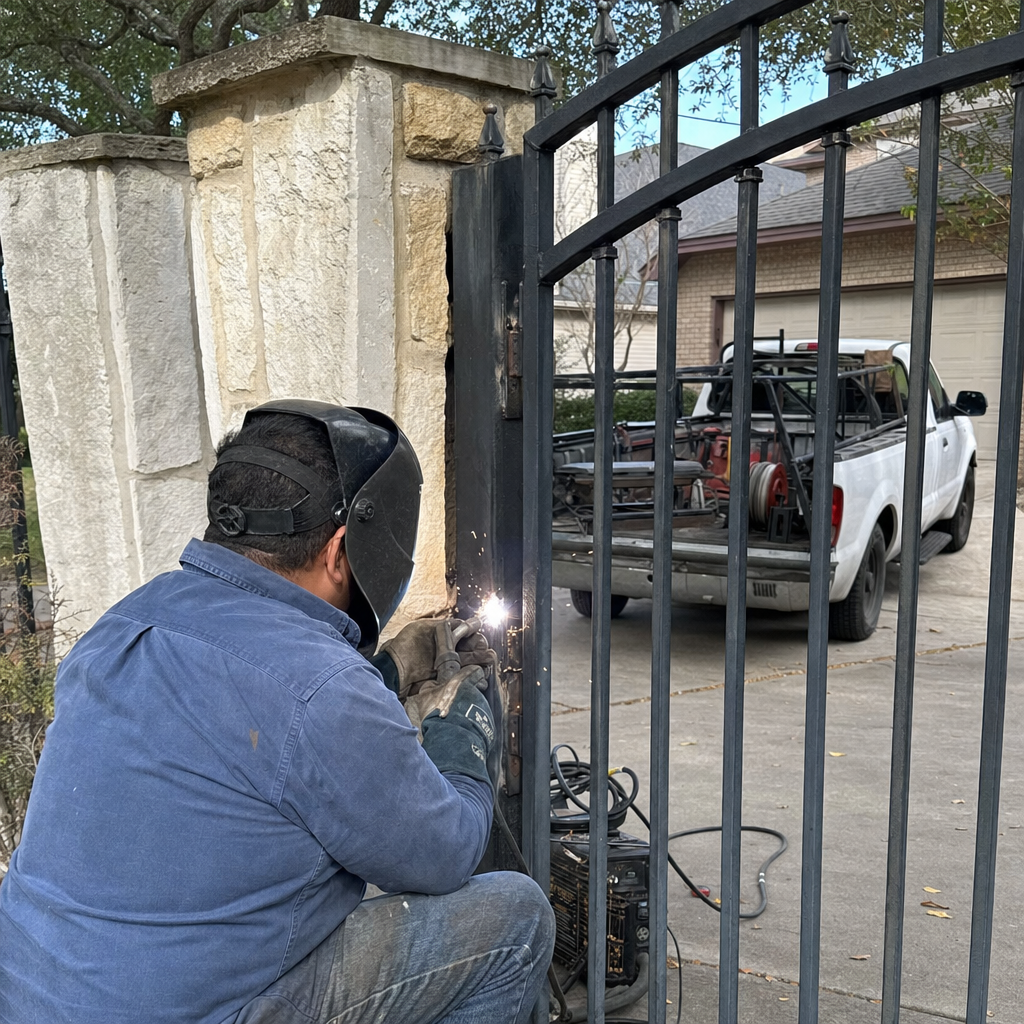
- Resetting a shifted gate post — even if you’re putting it back where it was, disturbing and re-setting a footing is structural work
- Replacing a masonry gate pillar — new concrete work requires a permit in Plano and most Collin County cities
- Widening a gate opening — changing the span between posts alters the structural footprint
- Adding a gate where none existed — this is new construction, not repair
- Installing a new concrete apron or vehicle gate pad — flatwork connected to the gate structure typically requires a permit
- Running a new dedicated electrical circuit to power an operator — see the electrical section below
In our nearly two decades of gate work across the Plano area, we’ve watched homeowners skip a permit on a post reset — often because the scope looked minor — and then face compliance issues years later. The post is the structural anchor of everything else. If it moves, everything above it is affected.
Plano vs. Collin County: Which Code Governs Your Project?
This question trips up a lot of property owners, particularly those on the edges of Plano where city limits and county jurisdiction can feel ambiguous. The answer comes down to whether your property is inside an incorporated city’s limits.
If you’re inside Plano city limits: The City of Plano Building Inspection Division has authority. Plano has adopted the 2021 International Building Code, 2021 International Residential Code (IRC), and 2020 National Electrical Code (NEC), with local amendments. Residential fence and gate permits in Plano are processed through the city’s online permitting portal and typically require a site plan showing the gate location, dimensions, and setbacks from property lines.
If you’re in unincorporated Collin County: Collin County itself has limited building code jurisdiction for residential structures — Texas counties generally do not enforce the IBC on single-family residential properties outside city limits unless a specific local order exists. This means some homeowners in rural or semi-rural parts of Collin County have less oversight. However, this does not mean no oversight: deed restrictions, HOA rules, and flood plain regulations may still apply, and any electrical work must still comply with the NEC regardless of permit status.
ETJ (Extraterritorial Jurisdiction): Plano’s ETJ is limited compared to larger cities, but properties in the ETJ of any incorporated Texas city may be subject to that city’s subdivision and platting rules, which can include fence and gate standards. Always confirm your specific parcel’s jurisdiction before assuming county rules apply.
When in doubt, the fastest way to confirm jurisdiction is to look up your property on the Collin County Appraisal District (CCAD) website and then call the jurisdiction’s building department directly.
Electrical Work and Gate Operators: When a New Permit Is Required
Replacing a gate motor on an existing electrical circuit — say, swapping an aging Linear operator for a new Viking or LiftMaster model on a circuit that’s already in place — generally does not require an electrical permit in Texas. The operator is treated as a plug-in or low-voltage appliance on an existing system.
A permit is required when the electrical scope goes beyond that baseline:
- Installing a new dedicated circuit from the main panel or sub-panel to the gate operator location — this is new electrical work and requires a licensed electrician to pull an electrical permit in Plano.
- Adding a hardwired access control system with its own power supply, particularly systems that integrate into the home’s main electrical panel.
- Installing gate lighting tied to a new circuit rather than an existing outdoor outlet.
- Any work inside the electrical panel — breaker additions, load calculations, or sub-panel work to support a new operator.
Brands like FAAC and BFT — European operators we service regularly — often draw specific power requirements that differ from standard North American operators. A FAAC 391 or BFT Deimos series unit may require a dedicated 20-amp circuit where an older Ghost Controls or Ramset operator was running off a shared outdoor circuit. That upgrade in wiring, however minor it sounds, triggers an electrical permit in Plano.
The practical takeaway: confirm the new operator’s power requirements before you commit to a brand. We always review this with homeowners upfront so there are no electrical-permit surprises mid-project.
HOA Architectural Approval vs. Municipal Permit: You Can Need Both
In many Plano neighborhoods — Legacy, Willow Bend, Kings Ridge, and virtually every gated subdivision built after 1995 — HOA Covenants, Conditions & Restrictions (CC&Rs) layer an entirely separate approval process on top of city permit requirements. These two systems operate independently, and getting one doesn’t satisfy the other.
Which comes first? Secure HOA approval before you pull the municipal permit. Here’s why: if the HOA rejects your gate design or material choice after the city has already issued a permit, you’ve spent permit fees and possibly contractor mobilization costs on a project you can’t legally proceed with under your deed restrictions. HOA architectural review committees typically meet on a set schedule — some only monthly — so starting that process early prevents scheduling delays.
Key HOA approval considerations specific to gate projects:
- Material and finish specifications — many Plano-area HOAs specify wrought iron, powder-coated steel, or wood species and prohibit chain-link or unpainted metal
- Gate height restrictions — front-yard gates in particular are often capped at 4–6 feet by HOA rules, which may be more restrictive than the city’s zoning setback rules
- Motor and operator visibility — some HOAs require that operators be screened or that control boxes match the fence finish
- Keypad and intercom placement — DoorKing and similar access control systems may need to match a subdivision-standard appearance
- Approval for like-for-kind replacement — some HOAs require notification even for repairs that don’t change the gate’s appearance
If your HOA’s CC&Rs are unclear on any of these points, get written clarification from the architectural committee before work begins. A verbal “that should be fine” from a neighbor on the board is not approval.
What Happens When Unpermitted Gate Work Surfaces During a Home Sale
This is the scenario we’ve seen cost Plano homeowners real money — not because the gate work was bad, but because it was done without the required permit years earlier and nobody thought about it until a buyer’s inspector flagged it.
In Texas real estate transactions, sellers are required to disclose known defects and non-permitted work. When an inspector notes a gate structure that shows evidence of post work, new concrete, or structural modification without a corresponding permit on file with the city, the following can happen:
- The buyer’s lender requires resolution before closing — particularly on FHA or VA loans, which have stricter property condition requirements. The lender’s appraiser may flag the unpermitted structure as a condition of the loan.
- An escrow hold is placed — funds are withheld pending either a retroactive permit and inspection, or removal and restoration of the original structure.
- Retroactive permitting — Plano’s Building Inspection office does allow applications for permits after the fact, but the process typically requires exposing the work for inspection (which may mean removing concrete or cladding to verify the footing), and there may be administrative fees beyond the standard permit cost.
- Forced removal — if the work doesn’t meet current code and can’t be brought into compliance, the city can require removal at the homeowner’s expense.
- Title issues — in some cases, unpermitted structural work can complicate title insurance, creating delays that push closing dates or cause a deal to fall apart entirely.
The cost of a retroactive permit process is almost always higher — in time, fees, and stress — than pulling the permit correctly before the work started. We’ve seen this play out enough times in the Plano market that we bring it up proactively on any job that touches structure.
The Contractor’s Role in Permit-Pulling: Who’s Responsible and How to Confirm It
In Texas, when permitted work is required, it’s the licensed contractor who is typically responsible for pulling the permit — not the homeowner. This is because the permit is tied to the contractor’s license, and the city needs to know who is accountable for the work meeting code. A homeowner can pull an owner-builder permit for work on their own primary residence in some cases, but for gate work involving structural or electrical scope, using a licensed contractor who pulls the permit in their own name is the cleaner and more legally protective path.
Where homeowners get into trouble is assuming the contractor has pulled the permit without confirming it. Here’s how to protect yourself:
- Ask before signing the contract — “Is a permit required for this scope? If so, who pulls it?” Get the answer in writing, ideally in the contract itself.
- Request the permit number before work begins — Plano’s permit portal allows anyone to look up active permits by address. Verify the permit exists before the crew starts digging or setting posts.
- Confirm inspection scheduling — some permitted work requires inspections at specific stages (e.g., before concrete is poured over a footing). Make sure the contractor has scheduled the required inspections, not just pulled the permit.
- Get the final inspection sign-off — a permit that was pulled but never received a final inspection is still an open permit. At home sale, an open permit can create the same issues as no permit at all.
- Keep a copy of everything — permit application, approval, and final inspection certificate. Store them with your property records.
Ryan handles permit coordination directly on jobs where it’s required — not delegated to a subcontractor you’ve never met. That’s the accountability that comes with an owner-operated business rather than a dispatch-model crew.
What to Expect During a Gate-Related Inspection in Plano
Inspections on permitted gate work in Plano are handled by the city’s Building Inspection Division. The inspector assigned depends on the type of work: a structural inspection covers post footings and masonry; an electrical inspection covers new circuits and low-voltage access control wiring.
For a typical permitted gate project involving post-setting and a new operator circuit, expect at minimum two inspection stages:
- Footing inspection (pre-pour) — the inspector visits after the post holes are dug and forms are set, but before concrete is poured. This is the most critical inspection: if the footing depth, diameter, and placement don’t meet code, corrections are required before the pour. In Plano’s clay-heavy soil — which expands and contracts significantly through wet winters and hot summers — footing depth requirements are taken seriously because inadequate footings are a primary cause of post heave and gate misalignment.
- Final inspection — after the gate and operator are fully installed. The inspector verifies the gate meets the approved plans, the operator is properly installed, and any electrical work is complete and code-compliant.
For access control systems — DoorKing intercoms, keypad entry, or integrated systems — a low-voltage inspection may also be required depending on the scope of wiring involved.
Scheduling inspections in Plano is done online or by phone through the city’s Building Inspection department. Lead times vary by season; spring (March through May) tends to be the busiest inspection period as construction activity ramps up across the DFW area. Plan accordingly and don’t pour concrete or close up electrical work before the relevant inspection is complete.
Common Mistakes to Avoid
- Assuming a motor swap and a post reset are both “just repairs.” Replacing a motor on an existing post is repair; disturbing and re-setting that post’s footing is structural work. In Plano and most Collin County cities, the latter requires a permit regardless of how similar the finished product looks.
- Pulling the municipal permit before getting HOA approval. HOA architectural review timelines in Plano-area subdivisions can run 4–6 weeks. Starting with the HOA and then the city avoids the situation where you’re permitted but blocked by your deed restrictions.
- Taking a contractor’s verbal assurance that “we handle the permit.” Always verify the permit exists on the city’s portal before work begins. An open or unpulled permit discovered during a home sale is just as problematic as no permit at all.
- Ignoring Plano’s clay soil when sizing gate post footings. The expansive clay that runs through much of Plano and the surrounding DFW area requires deeper, wider footings than what’s typical in other Texas regions. Under-sized footings are the single most common reason we see gate posts heave and gates fall out of alignment within 2–3 years of installation.
- Upgrading to a higher-amperage operator without checking circuit capacity. Switching from a Ghost Controls or Ramset unit to a FAAC or BFT operator — which often draws more power — on an existing circuit that wasn’t sized for the new load can cause breaker trips, operator failures, and a code violation if the wiring wasn’t upgraded to match.
- Leaving a permit open after the job is done. A permit that was pulled but never received a final inspection is a legal liability. Confirm the final inspection is scheduled and completed before you consider the project closed.
- Not disclosing prior unpermitted work when selling. Texas requires disclosure of known defects. If you’re aware that a previous owner or contractor did structural gate work without a permit, disclosing it and resolving it before listing is far less expensive than a buyer’s inspector flagging it mid-escrow.
When to Call a Professional
Call a licensed gate specialist before you start any project that involves setting or moving a post, pouring concrete, running new electrical, or replacing a gate entirely. These are the scopes where permit requirements, footing specifications, and electrical code intersect — and getting any one of them wrong creates downstream problems that cost significantly more to fix than the original job.
In our experience across nearly two decades of gate work in Plano and the surrounding area, the projects that end up most complicated are the ones where a homeowner or general handyman started without confirming permit requirements and then called us to untangle the situation. The fix almost always costs more than starting correctly would have.
If you have a gate project in Plano — whether it’s a repair that might be crossing into structural territory, a full installation, or an operator upgrade with electrical implications — First Choice Gate Repair Murphy offers free estimates and can tell you upfront whether a permit is required for your specific scope. Call (844) 352-2864 to speak with Ryan directly.
Frequently Asked Questions
No — replacing a gate motor on an existing circuit and existing post structure is generally classified as a repair or replacement-in-kind and does not require a permit in Texas, including in Plano. A permit is required if the motor upgrade requires a new dedicated electrical circuit or any changes to the post or gate structure. Call (844) 352-2864 for a free assessment of your specific project scope.
Yes, in most cases. Disturbing and re-setting a gate post — even to return it to its original location — constitutes structural work under Plano’s adopted building code. The footing must be inspected before concrete is poured. This is one of the most common permit oversights we see in the Plano market, particularly after wet winters that cause post heave in the area’s clay-heavy soil.
Yes, and it’s more common than most sellers expect. In Texas, unpermitted structural work discovered during a buyer’s inspection can trigger escrow holds, lender conditions, retroactive permitting requirements (including exposed inspections of buried work), and in some cases forced removal. Addressing it before you list — with a retroactive permit if possible — is almost always less expensive than resolving it under closing deadline pressure. Call (844) 352-2864 to discuss options.
If your property is inside Plano city limits, the City of Plano Building Inspection Division governs your project under the 2021 IBC, 2021 IRC, and 2020 NEC with local amendments. If you’re in unincorporated Collin County, Texas counties have limited residential building code authority and the city code doesn’t apply — but HOA deed restrictions and electrical code requirements may still govern your project. Confirm your jurisdiction on the Collin County Appraisal District (CCAD) site or by calling the relevant building department.
No — HOA architectural approval and a municipal building permit are entirely separate requirements and neither one substitutes for the other. Your HOA approval confirms your project complies with your subdivision’s deed restrictions; the city permit confirms it complies with building code. For permitted gate work in a Plano HOA community, you need both. Secure HOA approval first, since their review timeline is typically longer than the city’s permit processing time.
In Texas, licensed contractors typically pull the permit in their own name and are responsible for ensuring inspections are completed. As a homeowner, your protection is to confirm the permit exists on the city’s portal before work begins, verify that inspection stages are scheduled, and get the final inspection certificate when the job is complete. Never accept a verbal assurance alone — put permit responsibility in the written contract. Call (844) 352-2864 and Ryan will walk you through exactly what’s required for your project before a contract is signed.
The Bottom Line
The line between a no-permit gate repair and a permit-required structural alteration in Texas is narrower than most homeowners expect — and it’s drawn around the structure, not the motor. In Plano, where clay soils shift posts, HOA rules layer on top of city code, and home sale disclosures make prior unpermitted work a real liability, getting this right from the start is worth the upfront attention. Know which jurisdiction governs your parcel, confirm HOA approval before pulling a city permit, verify your contractor has actually pulled and closed the permit, and treat any work that touches a footing as structural until confirmed otherwise.
Written by Ryan Perez, Owner & Lead Technician at Gate Repair in Murphy — First Choice Gate Repair Murphy, serving Plano since 2007. Explore our Gate Installation in Murphy and Gate Motor & Opener in Murphy services for full-scope project support.